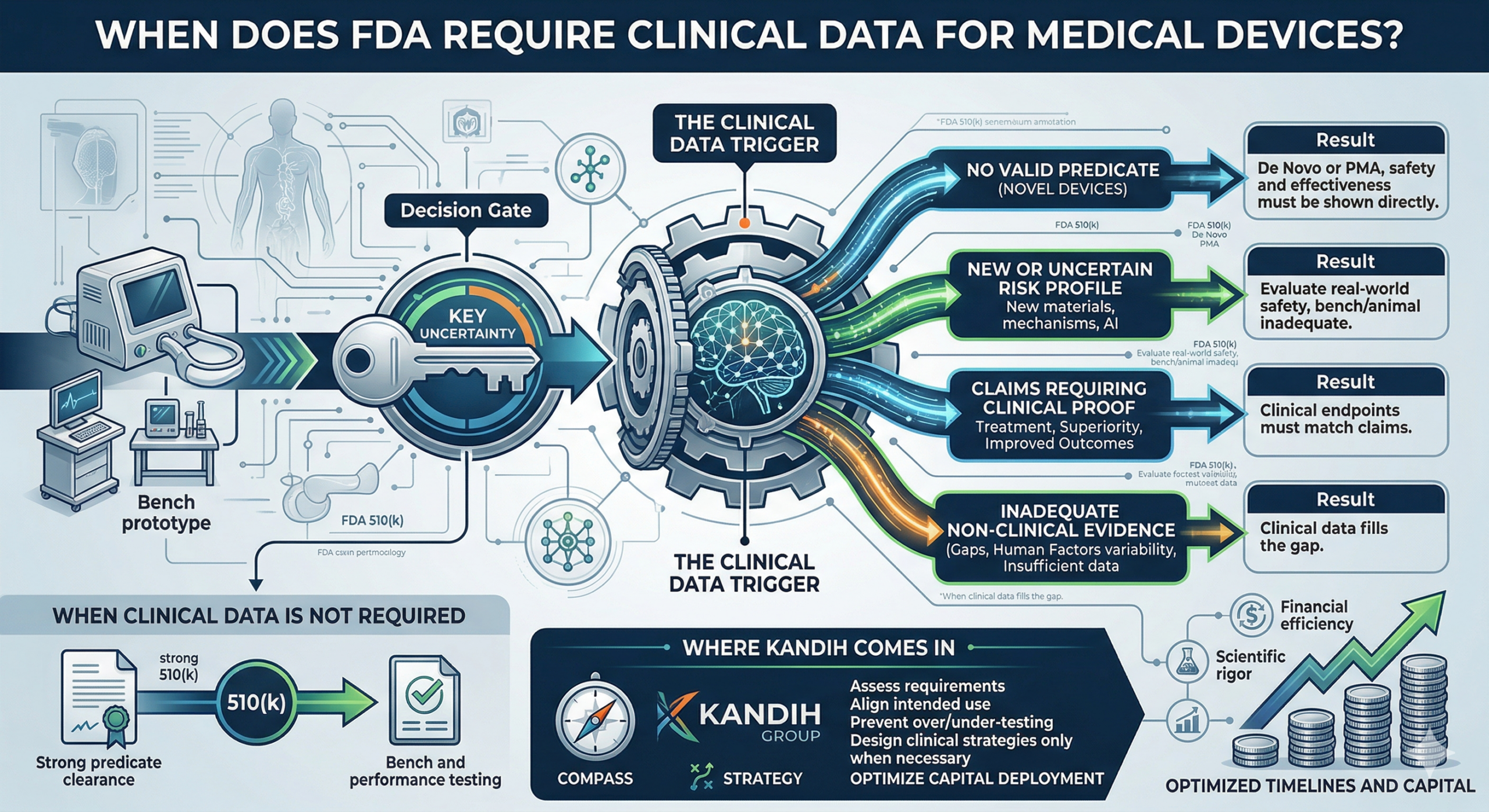
When Does FDA Require Clinical Data for Medical Devices?

Short answer: the FDA requires clinical data when risk, uncertainty, or lack of precedent cannot be addressed through non-clinical testing.

Clinical trials are not automatic.
They are triggered.

And most founders misunderstand when that trigger actually happens.

The Story Most Founders Live Through

A founder builds a promising device.
The prototype works. Bench testing looks strong. Early feedback is positive
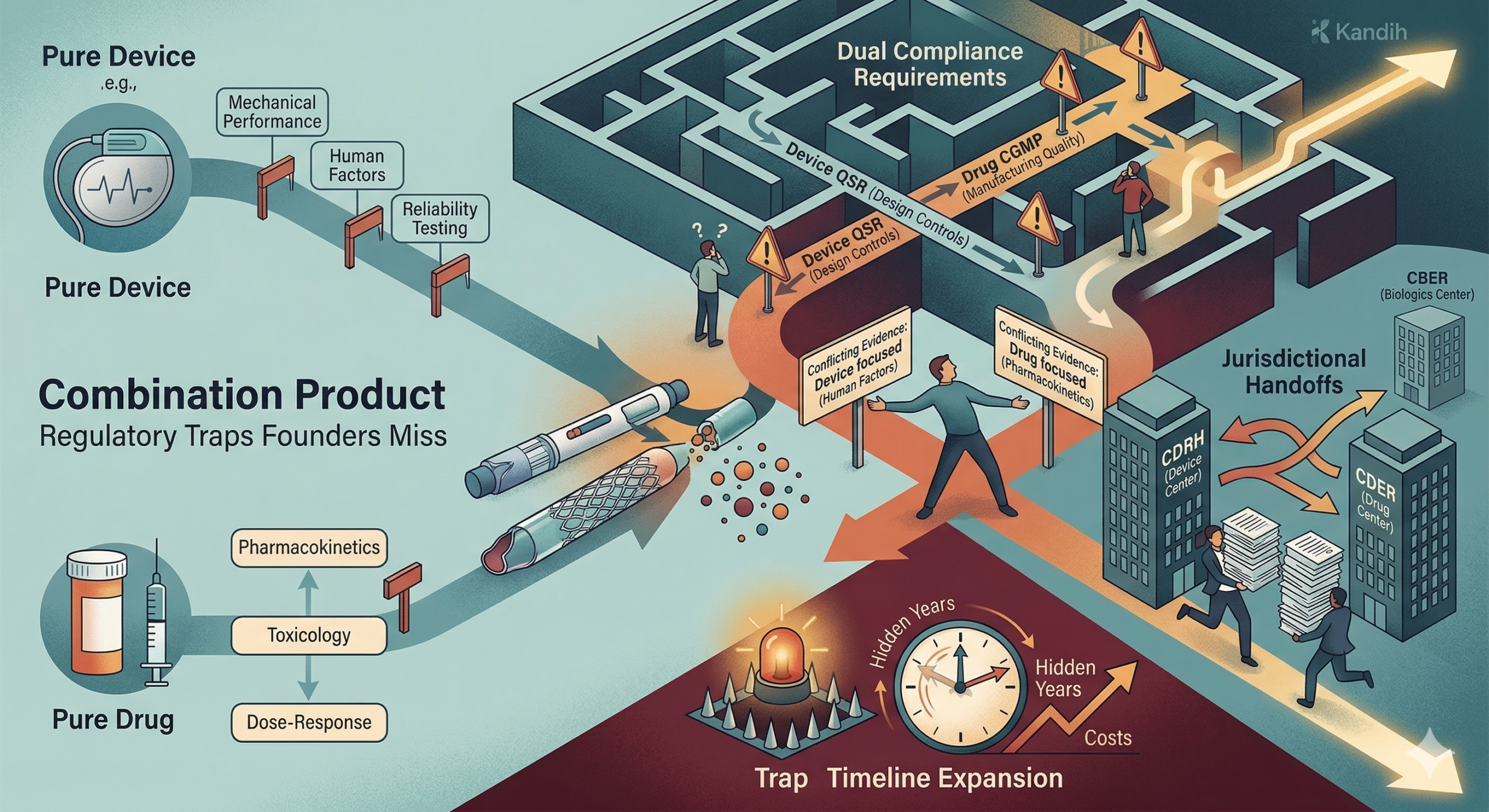
Combination Product Regulatory Traps Founders Miss

Short answer: combination products are often harder to develop than pure devices or pure drugs because they must satisfy multiple regulatory frameworks at the same time.

Many founders assume that combining a device with a drug simply means choosing one regulatory pathway. In reality, combination products often require dual compliance, complex evidence strategies, and coordination across different parts of the U.S. Food and Drug Administration.

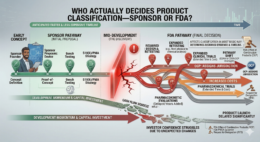
Who Actually Decides Product Classification—Sponsor or FDA?

Short answer: the sponsor proposes a classification, but the final decision belongs to the FDA.

Many companies assume they can simply decide whether their product is a device, drug, or combination product. In practice, the U.S. Food and Drug Administration determines the final regulatory classification.

This matters because classification determines which regulatory center reviews the product, what evidence is required, and how long development may take.

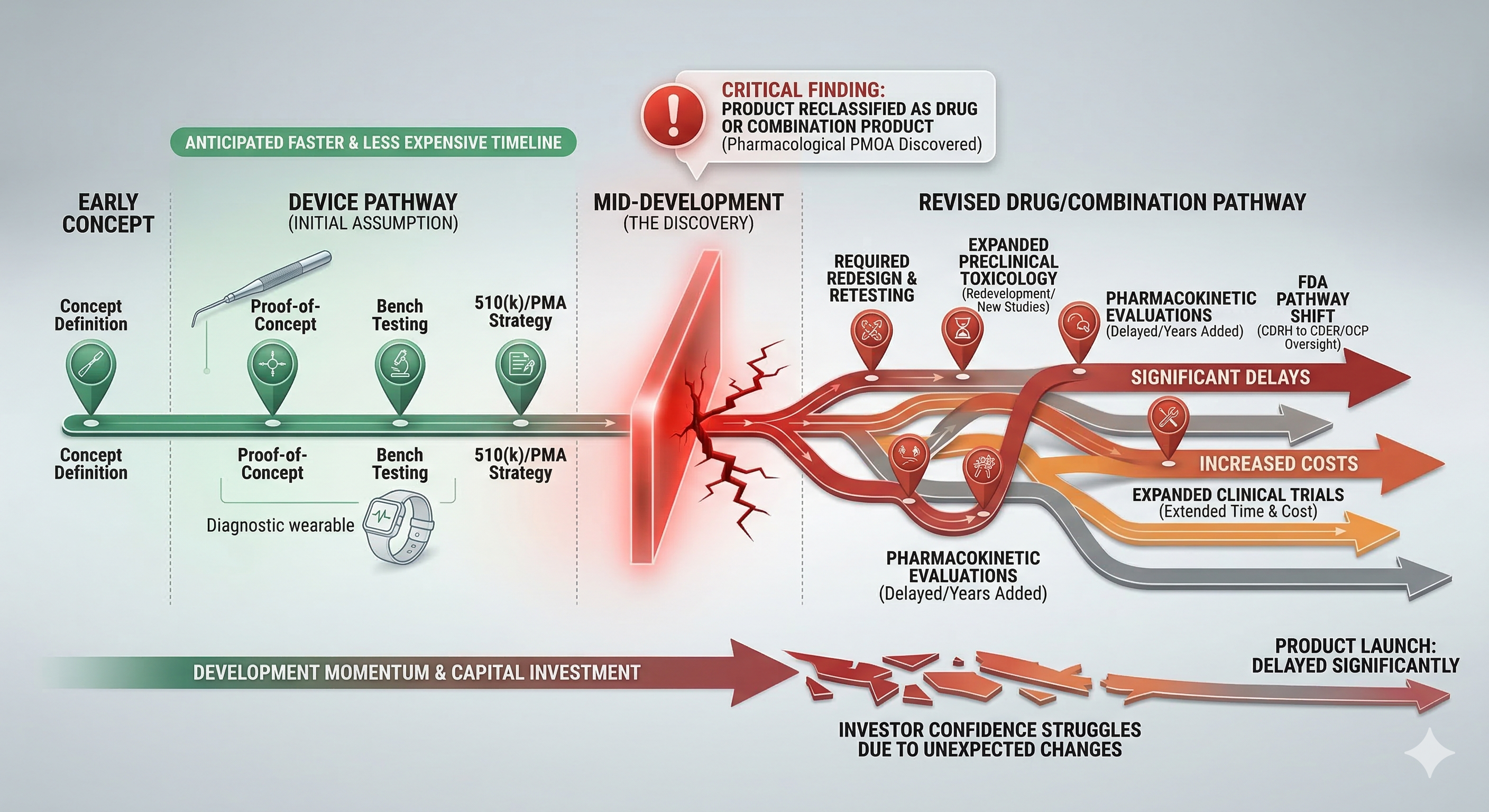
Why Misclassification Quietly Kills Timelines

Short answer: product misclassification rarely causes immediate failure—but it quietly destroys timelines later.

Many companies begin development assuming their product is a medical device because that pathway often appears faster and less expensive. Months—or even years—later, they discover the product functions more like a drug or combination product

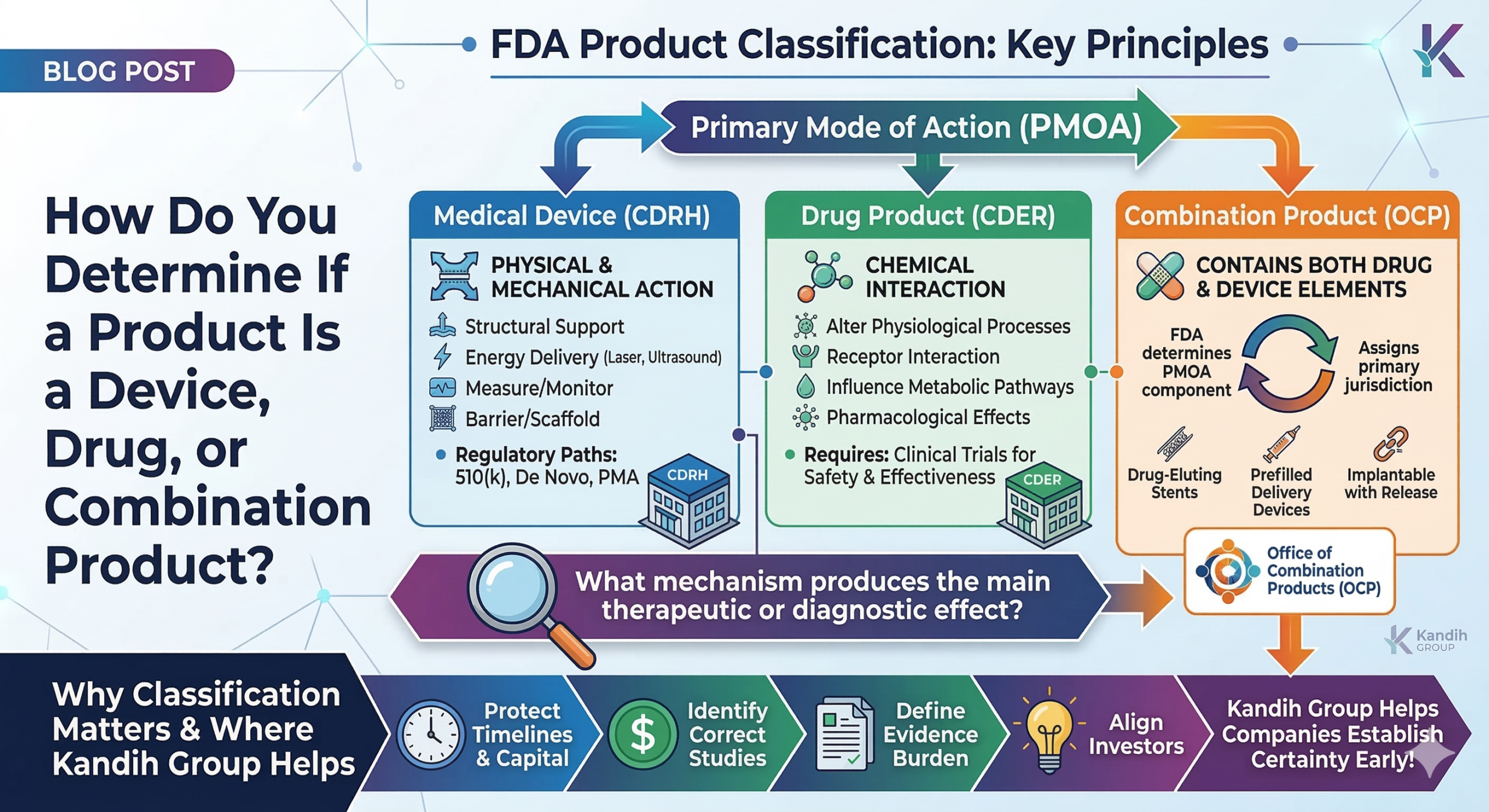
How Do You Determine If a Product Is a Device, Drug, or Combination Product?

Short answer: the classification depends on the product’s primary mode of action (PMOA)—how the product achieves its main intended effect in the body.

This determination matters because it decides which center of the U.S. Food and Drug Administration will regulate the product and what type of evidence will be required.

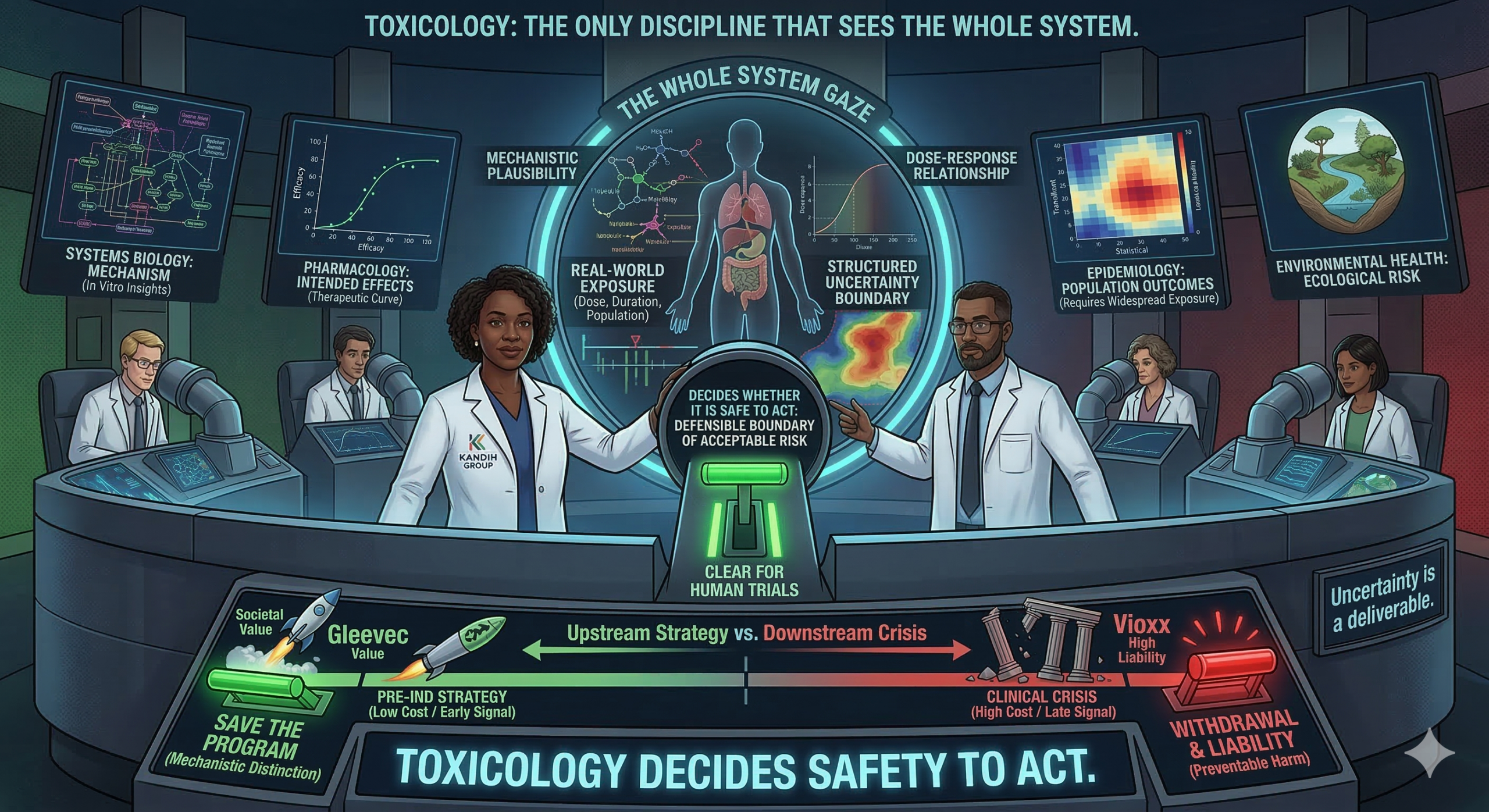
Toxicology Is the Only Discipline ThatSees the Whole System

By Harriet Kamendi | Regulatory Toxicologist | Kandih Group Imagine you are a founder. You have compelling efficacy data, a clean mechanismof action, and enough runway to file an IND. Your investors are excited. Yourscientific advisory board is aligned. And your toxicology package consists of asingle 28-day rat study and a literature review.You are not […]

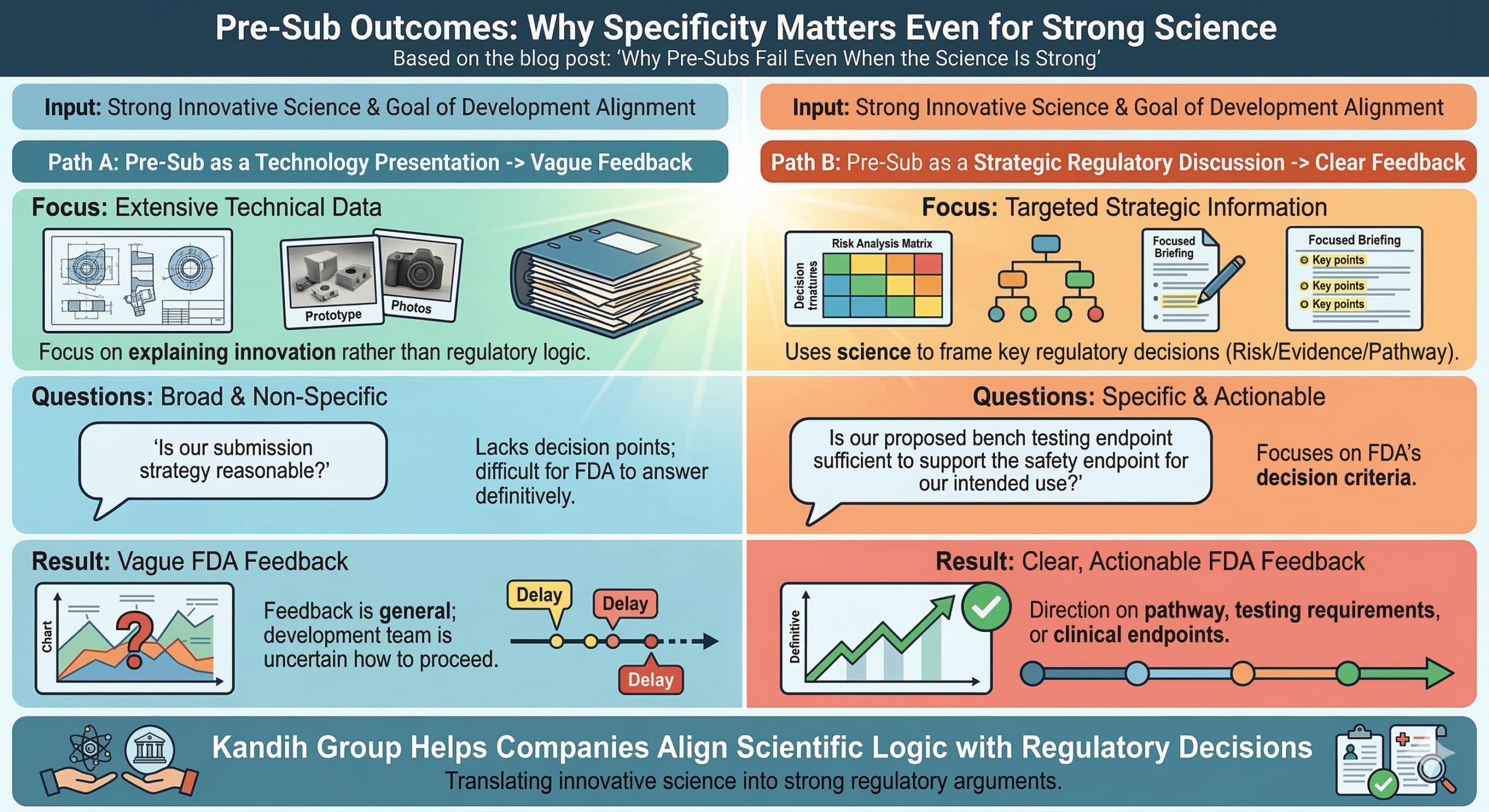
Why Pre-Subs Fail Even When the Science Is Strong

Short answer: Pre-Submissions (Pre-Subs) often fail not because the science is weak, but because the wrong regulatory questions were asked.

Many companies approach a Pre-Submission thinking the goal is to prove the device works. In reality, the goal is to align the development plan with the expectations of the U.S. Food and Drug Administration before major investment decisions are made

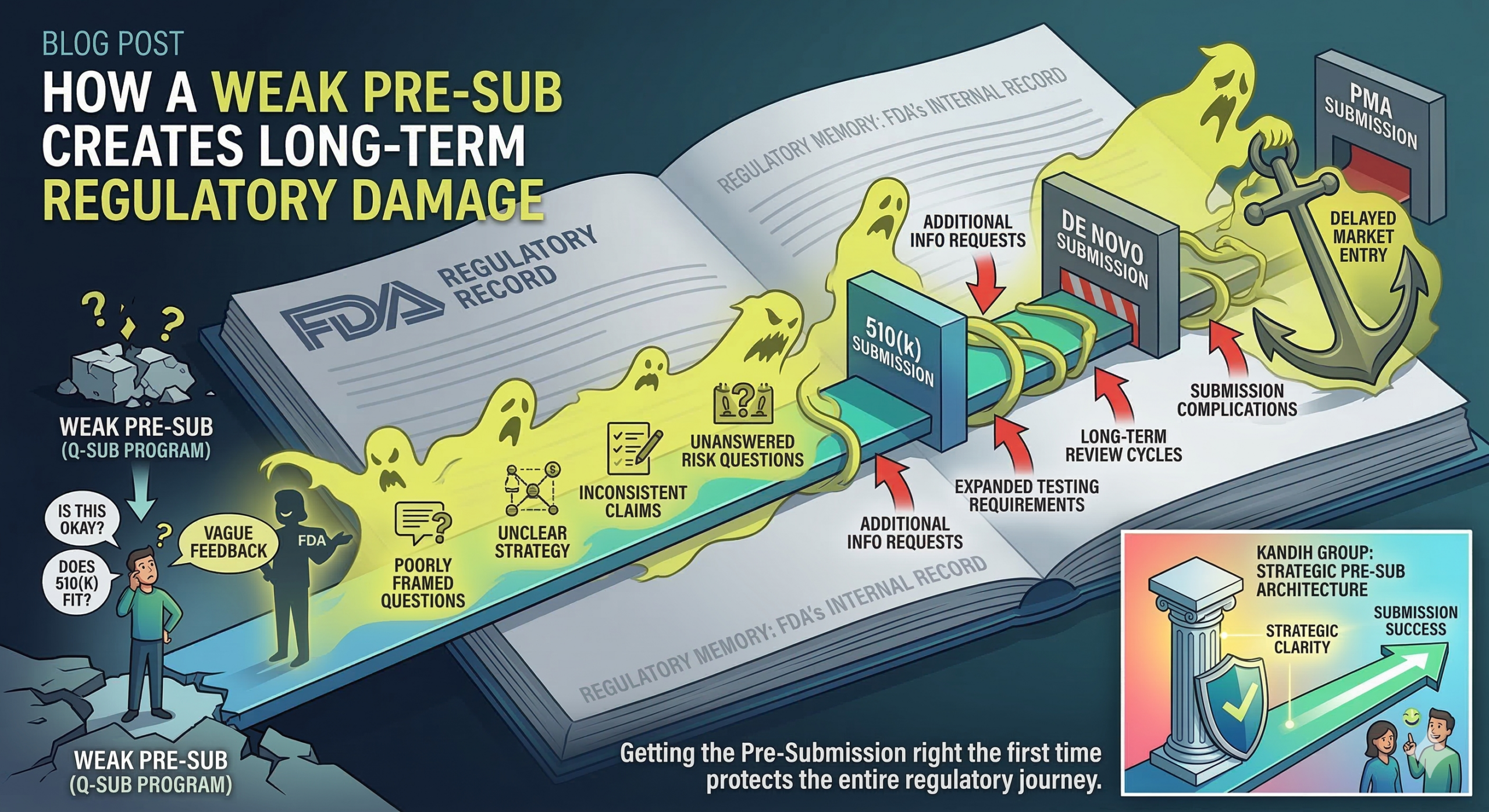
How a Weak Pre-Sub Creates Long-Term Regulatory Damage

Short answer: a weak Pre-Submission (Pre-Sub) does not just waste a meeting with the FDA. It creates a regulatory record that can follow your device through the rest of development.

Many founders treat a Pre-Sub as a casual conversation with the U.S. Food and Drug Administration. In reality, it is a formal interaction within the FDA’s Q-Submission program. The discussion becomes part of the agency’s internal regulatory history for your device.

💬

Chat with us