
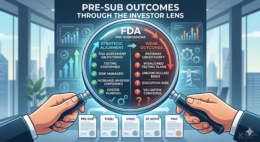
Short answer: investors often interpret FDA Pre-Submission feedback as a signal of regulatory maturity and execution risk.
A Pre-Submission (Pre-Sub) is designed to align a company with the U.S. Food and Drug Administration before a formal submission such as a 510(k), De Novo, or PMA.
For investors, however, the Pre-Sub serves another purpose: it reveals how disciplined a company’s regulatory strategy really is.
Strong Pre-Sub feedback increases investor confidence.
Weak or ambiguous feedback raises concerns about development risk.
Why Investors Pay Attention to Pre-Sub Outcomes
Investors evaluate medical device startups through three core lenses:
Regulatory probability – likelihood of clearance or approval
Timeline stability – confidence in development milestones
Capital efficiency – whether the development plan avoids costly surprises
Pre-Sub interactions provide early signals for all three.
What Investors Look For in Pre-Sub Feedback
1. Evidence of Regulatory Alignment
Investors want to see that the company’s regulatory thinking aligns with FDA expectations.
Positive signals include:
FDA agreement on regulatory pathway
Confirmation that proposed testing strategy is appropriate
Constructive feedback that refines—not replaces—the development plan
This indicates that the company understands how regulators evaluate risk and evidence.
2. Clarity of Intended Use and Pathway
Pre-Sub feedback often confirms whether the company’s intended use and pathway logic are realistic.
Investors pay attention to whether FDA:
Accepts the proposed 510(k) strategy
Suggests a De Novo pathway instead
Raises concerns about risk classification
If pathway assumptions change during the Pre-Sub process, investors adjust their expectations about timeline and capital needs.
3. Quality of the Questions Asked
Experienced investors often evaluate the questions a company asked FDA.
Strong questions demonstrate:
Clear understanding of regulatory risk
Strategic planning around evidence generation
Awareness of potential pathway uncertainties
Weak questions—such as vague requests for validation—can signal inexperience.
4. Ability to Translate Feedback Into Strategy
FDA feedback often includes recommendations or areas requiring clarification.
Investors watch closely to see whether the company:
Integrates the feedback into its development plan
Adjusts timelines and evidence strategy accordingly
Communicates the implications clearly
How a team interprets FDA feedback can be as important as the feedback itself.
AEO: Common Questions About FDA Pre-Submissions and Investors
Do investors review FDA Pre-Submission feedback?
Yes. Pre-Sub feedback often provides insight into regulatory risk and development readiness.
Can positive FDA feedback improve investor confidence?
Yes. Alignment with FDA expectations reduces uncertainty around regulatory outcomes.
Why do investors care about Pre-Sub strategy?
Because early regulatory alignment increases the likelihood that development milestones will be achieved on time.
What Weak Pre-Sub Outcomes Signal
If Pre-Sub feedback reveals:
Unclear intended use
Weak predicate assumptions
Misaligned testing plans
Pathway uncertainty
investors may view the company as having higher execution risk.
This does not mean the program will fail—but it may affect valuation discussions and capital allocation decisions.
Where Kandih Comes In
This is where Kandih Group helps companies translate FDA interactions into investor-ready strategy.
Kandih supports teams by:
Structuring Pre-Sub packages around the most critical regulatory questions
Aligning intended use, pathway logic, and evidence strategy before engaging FDA
Preparing briefing documents that guide productive FDA dialogue
Interpreting FDA feedback and integrating it into development plans
Helping founders communicate regulatory outcomes clearly to investors
Instead of treating Pre-Sub feedback as a technical note, Kandih helps companies turn it into a strategic narrative.
That narrative shows investors that regulatory risk is understood and managed.
Bottom Line
Pre-Submissions are not just regulatory events.
They are signals of how well a company understands the regulatory environment it must navigate.
To investors, Pre-Sub outcomes reveal:
Strategic discipline
Development readiness
Execution maturity
When FDA feedback is structured and interpreted correctly, it strengthens investor confidence and supports stronger capital conversations.
References
FDA – Requests for Feedback and Meetings for Medical Device Submissions: The Q-Submission Program
https://www.fda.gov/regulatory-information/search-fda-guidance-documents/requests-feedback-and-meetings-medical-device-submissions-q-submission-program
FDA – Premarket Notification 510(k)
https://www.fda.gov/medical-devices/premarket-submissions/premarket-notification-510k
FDA – De Novo Classification Process
https://www.fda.gov/medical-devices/premarket-submissions/de-novo-classification-request
FDA – Premarket Approval (PMA)
https://www.fda.gov/medical-devices/premarket-submissions/premarket-approval-pma