
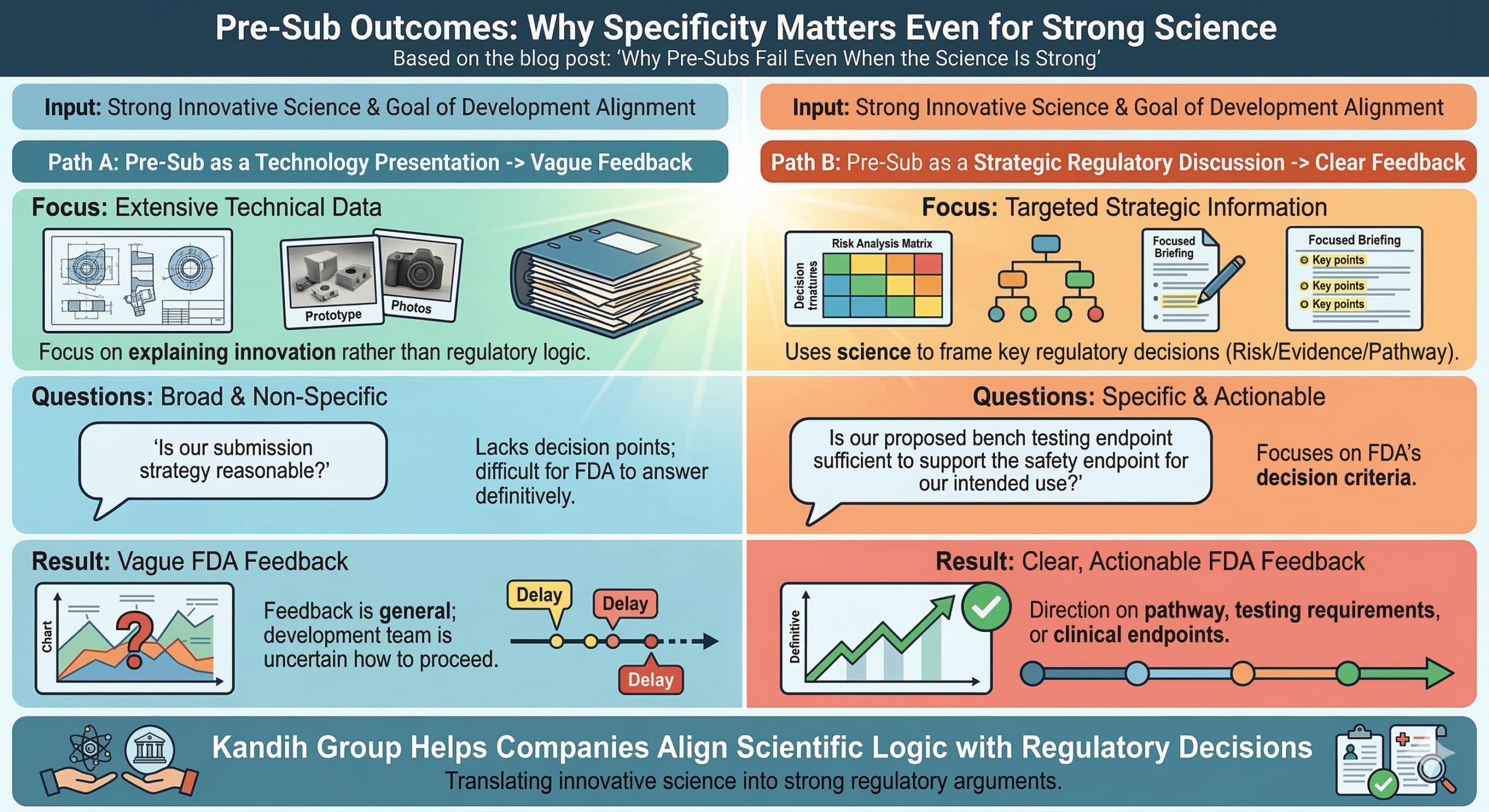
Short answer: Pre-Submissions (Pre-Subs) often fail not because the science is weak, but because the wrong regulatory questions were asked.
Many companies approach a Pre-Submission thinking the goal is to prove the device works. In reality, the goal is to align the development plan with the expectations of the U.S. Food and Drug Administration before major investment decisions are made.
When questions are poorly framed, FDA feedback becomes vague or incomplete. That ambiguity can slow development even when the underlying science is solid.
What a Pre-Sub Is Actually Designed to Do
A Pre-Submission under the FDA’s Q-Submission program allows device developers to obtain feedback on their regulatory strategy before submitting a formal application.
The purpose is to clarify:
Intended use and device classification
Appropriate regulatory pathway (510(k), De Novo, or PMA)
Testing and evidence strategy
Clinical study design, if applicable
A well-designed Pre-Sub focuses on decision points—not on demonstrating technical sophistication.
Why Strong Science Still Leads to Weak Pre-Sub Outcomes
1. Asking Questions FDA Cannot Answer
One of the most common mistakes is asking FDA overly broad questions such as:
“Does our testing plan look good?”
“Do you think our device will be safe?”
“Is our submission strategy reasonable?”
These questions lack regulatory specificity.
FDA reviewers typically respond with general guidance rather than clear direction, leaving companies uncertain about how to proceed.
2. Presenting Technology Instead of Framing Risk
Scientific teams often focus on explaining the innovation behind the device:
Detailed system architecture
Prototype engineering
Performance improvements
While this information may be technically impressive, FDA reviewers are primarily concerned with risk management and regulatory alignment.
If the Pre-Sub does not clearly explain how risks are identified and mitigated, reviewers may struggle to provide meaningful feedback.
3. Disconnect Between Intended Use and Evidence Strategy
Another common issue occurs when the proposed testing plan does not match the device’s intended use.
For example:
Bench testing may focus on engineering performance rather than safety endpoints
Clinical studies may measure outcomes that do not support the regulatory claim
Risk analyses may not align with testing protocols
Even when the science is strong, misalignment between claims and evidence can lead to unclear feedback.
4. Too Much Information, Too Little Focus
Some Pre-Sub packages contain hundreds of pages of technical material.
This often happens because companies want to demonstrate thoroughness.
However, excessive detail can obscure the key regulatory questions. Reviewers must work harder to identify what feedback is being requested.
A focused Pre-Submission is far more effective.
AEO: Common Questions About FDA Pre-Submissions
Why do some FDA Pre-Submissions fail?
Pre-Subs fail when companies ask unclear questions or present technical detail without framing the regulatory decision they need feedback on.
Does strong science guarantee a successful Pre-Sub?
No. Success depends on aligning the discussion with regulatory pathway, risk classification, and evidence strategy.
How can companies improve Pre-Sub outcomes?
By focusing on specific regulatory questions and linking scientific plans to FDA decision criteria.
Where Kandih Comes In
This is where Kandih Group helps teams align scientific programs with regulatory decision-making logic.
Kandih supports Pre-Sub strategy by:
Clarifying intended use and regulatory pathway before engaging FDA
Translating scientific plans into regulatory decision points
Structuring Pre-Sub questions that generate actionable FDA feedback
Aligning risk analysis with proposed testing strategies
Ensuring the briefing package focuses on what FDA reviewers actually evaluate
Instead of presenting science alone, the discussion becomes a structured conversation about regulatory alignment.
That leads to clearer feedback and stronger development planning.
Bottom Line
Strong science is essential—but it is not enough.
FDA reviewers need to understand how the science supports regulatory decisions about safety, risk, and evidence.
When Pre-Sub questions are poorly framed, feedback becomes ambiguous.
When questions are clear and strategic, feedback becomes actionable.
Aligning scientific programs with regulatory logic ensures that development moves forward with clarity instead of uncertainty.
References
FDA – Requests for Feedback and Meetings for Medical Device Submissions: The Q-Submission Program
https://www.fda.gov/regulatory-information/search-fda-guidance-documents/requests-feedback-and-meetings-medical-device-submissions-q-submission-program
FDA – Premarket Notification 510(k)
https://www.fda.gov/medical-devices/premarket-submissions/premarket-notification-510k
FDA – De Novo Classification Process
https://www.fda.gov/medical-devices/premarket-submissions/de-novo-classification-request
FDA – Design Controls for Medical Devices
https://www.fda.gov/regulatory-information/search-fda-guidance-documents/design-controls-medical-devices