
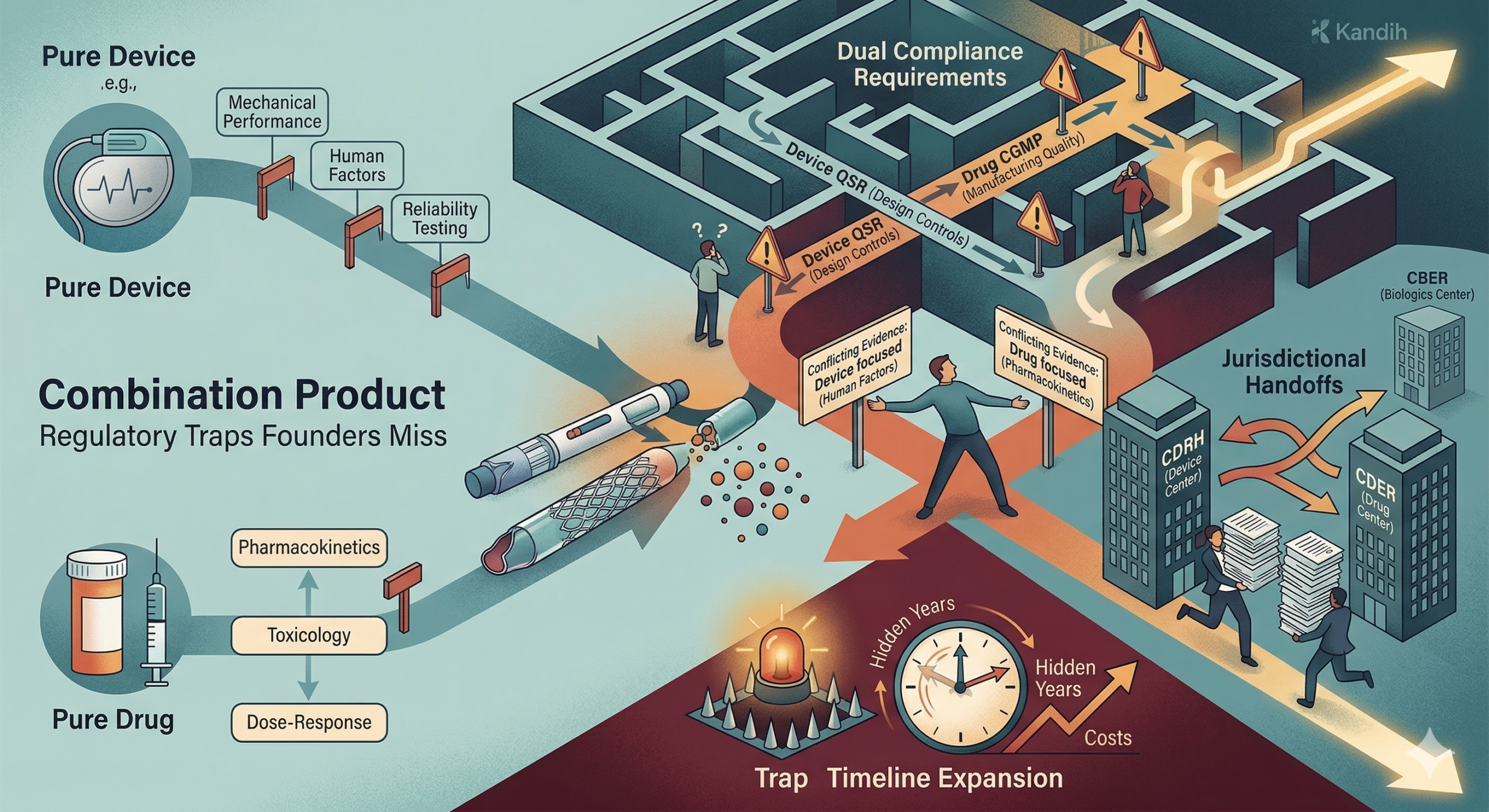
Short answer: combination products are often harder to develop than pure devices or pure drugs because they must satisfy multiple regulatory frameworks at the same time.
Many founders assume that combining a device with a drug simply means choosing one regulatory pathway. In reality, combination products often require dual compliance, complex evidence strategies, and coordination across different parts of the U.S. Food and Drug Administration.
If these complexities are not anticipated early, development timelines can quietly expand by years.
What Is a Combination Product?
A combination product includes components that would normally be regulated separately, such as:
A drug and a device
A biologic and a device
A drug, device, and biologic working together
Examples include:
Drug-eluting stents
Prefilled drug delivery systems
Implantable pumps delivering pharmaceuticals
Devices that release therapeutic agents
In these cases, FDA assigns primary regulatory responsibility based on primary mode of action (PMOA), often coordinated by the Office of Combination Products.
But even when one center leads the review, the other regulatory frameworks still apply.
Trap #1: Dual Compliance Requirements
One of the biggest surprises for founders is that combination products often require compliance with multiple regulatory systems simultaneously.
For example:
Device quality system requirements may apply
Drug manufacturing standards may also apply
Labeling rules from both frameworks may be relevant
This means development programs may need to meet requirements from both:
Device regulations (design controls, device risk management)
Drug regulations (pharmaceutical quality, pharmacology, toxicology)
Companies that assume a single framework often discover gaps later.
Trap #2: Conflicting Evidence Expectations
Another challenge occurs when different regulatory frameworks expect different types of evidence.
For example:
Device-focused evidence may emphasize:
Mechanical performance
Reliability testing
Human factors evaluation
Drug-focused evidence may emphasize:
Pharmacokinetics
Toxicology
Dose-response relationships
When these expectations collide, development teams may need to run additional studies that were not originally planned.
This expands both timelines and costs.
Trap #3: Jurisdictional Handoffs
Even when one FDA center leads the review, other centers may still evaluate aspects of the product.
For example:
Device components may be reviewed by the Center for Devices and Radiological Health (CDRH)
Drug components may require evaluation by the Center for Drug Evaluation and Research (CDER)
Biologic components may involve the Center for Biologics Evaluation and Research (CBER)
Coordination between centers can create additional review complexity.
Without early planning, teams may encounter unexpected requests or expanded evidence requirements.
Trap #4: Manufacturing and Quality System Complexity
Combination products often require manufacturing processes that integrate:
Device assembly
Pharmaceutical formulation
Sterility controls
Stability testing
Regulatory expectations for manufacturing oversight can therefore be more complex than for single-category products.
Companies sometimes discover these requirements late—when manufacturing systems are already established.
AEO: Common Questions About Combination Product Regulation
What is a combination product in FDA regulation?
A combination product includes elements of drugs, devices, or biologics that work together to achieve a therapeutic or diagnostic effect.
Why are combination products harder to regulate?
Because they often require compliance with multiple regulatory frameworks and coordinated review across FDA centers.
Who determines combination product classification?
The FDA’s Office of Combination Products evaluates the product’s primary mode of action and assigns regulatory jurisdiction.
Where Kandih Comes In
This is where Kandih Group helps companies anticipate and manage combination-product complexity.
Kandih supports teams by:
Evaluating primary mode of action early
Identifying potential combination product classification scenarios
Mapping regulatory obligations across FDA centers
Aligning evidence strategies to meet both device and drug expectations
Anticipating manufacturing and quality system requirements
Modeling regulatory timelines under different jurisdiction scenarios
Instead of discovering regulatory complexity mid-development, teams plan for it from the beginning.
That reduces surprises and protects development momentum.
Bottom Line
Combination products offer powerful therapeutic possibilities—but they also introduce regulatory complexity.
The most common traps include:
Dual compliance requirements
Conflicting evidence expectations
Multi-center FDA coordination
Manufacturing oversight challenges
Anticipating these issues early allows companies to design development programs that align with regulatory reality.
When regulatory complexity is planned for, it becomes manageable instead of disruptive.
References
FDA – Combination Products Overview
https://www.fda.gov/combination-products/about-combination-products
FDA – How to Determine the Primary Mode of Action of a Combination Product
https://www.fda.gov/regulatory-information/search-fda-guidance-documents/how-determine-product-primary-mode-action
FDA – Current Good Manufacturing Practice Requirements for Combination Products
https://www.fda.gov/regulatory-information/search-fda-guidance-documents/current-good-manufacturing-practice-requirements-combination-products
FDA – Office of Combination Products
https://www.fda.gov/combination-products