

Why activity feels good—but doesn’t always fix anything Why “doing something” feels like progress Checking a box feels productive.You sent the email.You updated the SOP.You held the training.You documented the CAPA. It feels like the problem is handled. But here’s the hard truth: activity is not the same as impact. In regulated environments, it’s easy […]
Blog

The danger of “just reminding people”
Why telling people to “be careful” doesn’t fix real problems When something goes wrong and the fix is “just remind people”, that’s not a solution. That’s a warning sign.In real life—busy labs, fast-moving studies, tight timelines—people don’t fail because they don’t care. They fail because systems are built to depend on memory, and memory is […]

When Should Regulatory Strategy Start for a Medical Device?
Regulatory strategy should start the moment you decide to build a medical device—before you lock the intended use, user, setting, claims, or design inputs. Those early choices determine FDA pathway, evidence burden, testing scope, quality system requirements, and clinical risk. If you start later, you don’t “add regulatory”; you inherit avoidable cost, delay, and valuation […]

When a Fix Isn’t Enough — When the Product Itself Has to Change
Let’s say the quiet part out loud. Most product problems don’t fail inspections because no one cared.They fail because everyone thought the problem was already handled. The investigation was done.The corrective action was documented.People were retrained.The CAPA was closed. On paper, it looks responsible. Then FDA walks in…And the same issue shows up again. That’s […]

CAPA – Design – Risk Management
CAPA Survival Playbooks — Kandih Bioscience FDA expects CAPA, design controls, and risk management to operate as one integrated risk-control system.If CAPA closes without updating design assumptions or risk management files, FDA interprets this as stalled learning and weak management control—regardless of how complete the documentation appears. When CAPA, Design, and Risk Stop Talking, FDA […]

Why CAPA Without DHF Updates Fails
CAPA Survival Playbooks — Kandih Bioscience A CAPA that does not result in a Design History File (DHF) update is not effective in FDA’s eyes.From an inspection perspective, CAPA is expected to feed design controls. If real-world failures do not change design inputs, risk analyses, or verification strategies documented in the DHF, FDA assumes the […]

FDA Expects CAPAs to Feed Design Controls
CAPA Survival Playbooks — Kandih Bioscience From an inspection perspective, a CAPA that stops in QA without informing design inputs, risk management, or validation is incomplete. Administrative closure does not demonstrate learning or restored control; only changes to design and risk assumptions do. When CAPAs Stop at QA, Inspections Don’tOne of the most reliable predictors […]
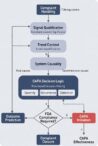
The Complaint-to-CAPA Mapping Checklist
CAPA Survival Playbooks — Kandih Bioscience Complaint-to-CAPA mapping is a risk-interpretation system, not an administrative checklist.FDA evaluates whether complaint signals are consistently interpreted, escalated, or deferred based on documented risk logic. If the linkage between complaint and CAPA cannot be explained deterministically, FDA treats it as loss of governance—regardless of documentation completeness. Why “End-of-Process” Checklists […]
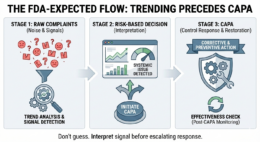
Do You Trend Complaints Before CAPA?
Yes—FDA expects complaint trending before CAPA initiation.From an inspection perspective, complaint trending is a diagnostic function, not an effectiveness check. If trending only occurs after CAPA opens, FDA assumes the escalation decision was not risk-informed and that the system reacted without understanding the signal. Why This Question Matters More Than Most Teams Realize If CAPA […]