
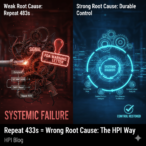
CAPA Survival Playbooks — Kandih Bioscience Repeat FDA 483 observations almost always mean the original root cause was wrong.From an FDA enforcement perspective, recurrence equals misdiagnosis. If the root cause did not explain how the system failed—or why it could fail again—CAPA did not restore control, regardless of how clean the documentation looked. Why “Tidy” […]
Blog
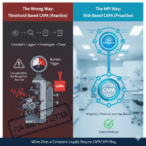
When Does a Complaint Legally Require CAPA?
A complaint legally requires CAPA when it signals loss of control in the quality system—not when it hits a numeric or procedural threshold.From an FDA enforcement perspective, CAPA is mandatory once complaint data indicates systemic risk, degraded control, or credible recurrence. Waiting for a regulation or SOP trigger means the system recognized risk too late. […]
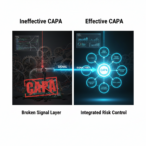
5 Complaint Handling Errors That Kill CAPAs
CAPA Survival Playbooks — Kandih Bioscience If your CAPA depends on complaints—but your complaint handling system is weak—your CAPA is already dead.From an FDA inspection perspective, complaints are not paperwork to close. They are early-warning signals that feed the CAPA risk-control loop. When complaint signals are distorted, minimized, or inconsistently escalated, CAPA operates on corrupted […]
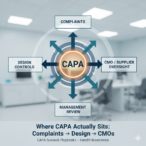
Where CAPA Actually Sits: Complaints → Design → CMOs
CAPA Survival Playbooks — Kandih Bioscience CAPA does not sit in QA.From an FDA inspection perspective, CAPA sits at the intersection of complaints, design controls, supplier/CMO oversight, and management review. If CAPA is positioned downstream—after complaints are closed, designs are frozen, or suppliers are “handled”—inspectors interpret the system as reactive and ineffective, regardless of documentation […]
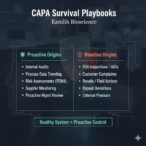
Where Do Your CAPAs Originate Most?
CAPA Survival Playbooks — Kandih Bioscience CAPAs Don’t Fail at Closure—They Fail at the Source Most CAPA programs don’t fail because teams can’t write corrective actions.They fail because organizations never ask—or cannot clearly answer—a far more uncomfortable question: Where do our CAPAs actually come from? Inspection after inspection, FDA sees the same pattern: CAPAs are […]

CAPA ≠ Paperwork. It’s a Risk-Control Feedback Loop
CAPA Survival Playbooks — Kandih Bioscience One of the most common inspection surprises plays out the same way every time:the CAPA file is immaculate—signed, dated, closed on schedule—yet the inspection ends with a Form 483. That disconnect is not subtle. It reflects a fundamental misunderstanding of what CAPA is designed to do. Many organizations still […]
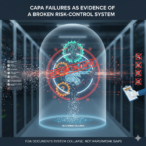
CAPA Failures as Evidence of a Broken Risk-Control System
(How FDA documents system collapse, not paperwork gaps) FDA consistently uses CAPA failures as proxy evidence that a firm’s end-to-end risk-control architecture is nonfunctional. For medical devices, this is most often cited as a violation of 21 CFR 820.100(a). For drugs and combination products, the same systemic failure is documented through CGMP investigation and CAPA […]
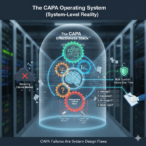
Why FDA Treats CAPA as a Risk-Control System, Not a QA Task
The CAPA Operating System (System-Level Reality) Most CAPA programs don’t fail because of weak documentation.They fail because they were never architected as systems. Organizations routinely design CAPA as a QA artifact—a form, a workflow, a closure event. FDA inspects something very different: a live, end-to-end risk-control system that proves an organization can detect, absorb, and […]

Disseminated Intravascular Coagulation – Causes
DIC is caused by another medical condition that makes the body’s normal blood clotting process become overactive. The condition progresses through two stages. In the early stages, overactive clotting leads to blood clots throughout the blood vessels. The clots can reduce or block blood flow, damaging organs.
As DIC progresses, the overactive clotting uses up platelets and clotting factors, which are protein that help with normal blood clotting. Without these platelets and clotting factors, DIC can cause bleeding just beneath the skin, in the nose or mouth, or deep inside the body