
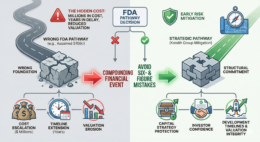
Direct answer: choosing the wrong FDA pathway does not just delay your launch. It can add millions in cost, years in delay, and materially reduce company valuation.
Most pathway mistakes happen early—when teams assume a 510(k) is viable without fully pressure-testing risk, intended use, or technological differences.
The problem? FDA pathway decisions are not flexible suggestions. They are structural commitments.
Under the framework of the U.S. Food and Drug Administration, risk classification determines evidence burden. And evidence burden determines capital burn.
When you choose the wrong pathway, you are building on the wrong foundation.
What Actually Happens When the Pathway Is Wrong
1. Cost Escalation
If a device assumed to qualify for a 510(k) must instead pursue De Novo or PMA, the evidence burden expands significantly.
Example Cost Impact:
Scenario Estimated Additional Cost
510(k) → De Novo pivot $1M–$3M
510(k) → PMA pivot $3M–$10M+
De Novo → PMA escalation $2M–$7M+
Why the jump?
Because higher-risk pathways require:
More extensive bench testing
Expanded biocompatibility programs
Human factors validation
Clinical trials
Longer FDA review cycles
These are not incremental add-ons. They are structural shifts.
2. Timeline Extension
Pathway pivots often add:
12–24 months (510(k) → De Novo)
24–48+ months (510(k) → PMA)
And that assumes capital is available to continue.
For early-stage startups, this timeline expansion directly increases burn rate and runway risk.
Delay is not just time lost. It is opportunity lost.
3. Valuation Erosion
Investors price risk.
When a regulatory pivot occurs:
Timeline certainty decreases
Capital requirements increase
Probability of exit decreases
This can result in:
Down rounds
Increased dilution
Loss of strategic partners
Reduced acquisition multiples
Regulatory misclassification is often invisible until diligence—but once discovered, it is expensive.
Why Teams Choose the Wrong Pathway
Common causes include:
Overestimating predicate similarity
Ignoring technological differences
Expanding intended use claims late
Assuming novelty equals moderate risk
Optimism driven by capital constraints
Regulatory optimism feels efficient early.
It becomes expensive later.
The Compounding Effect
Wrong pathway → More evidence → More time → More capital → Lower valuation → Harder fundraising.
By the time the pivot becomes visible, reversing it is no longer cheap.
That is why pathway selection is not a tactical decision. It is a strategic one.
Where Kandih Comes In
This is where Kandih Group acts as an early-stage pathway risk mitigator.
Kandih supports founders and investors by:
Conducting structured pathway viability assessments
Evaluating predicate strength and technological differences
Mapping intended use to realistic classification outcomes
Identifying hidden risk escalators
Modeling cost and timeline scenarios for each viable pathway
Stress-testing regulatory assumptions before capital deployment
Instead of hoping the pathway works, teams understand the regulatory exposure upfront.
That protects:
Capital strategy
Investor confidence
Development timelines
Valuation integrity
Bottom Line
Choosing the wrong FDA pathway is not a minor correction.
It is a compounding financial event.
The cheapest time to validate your pathway is before engineering hardens and investors commit capital.
That is how Kandih helps companies avoid six- and seven-figure mistakes—before they happen.
References
FDA – Classify Your Medical Device
https://www.fda.gov/medical-devices/overview-device-regulation/classify-your-medical-device
FDA – Premarket Notification 510(k)
https://www.fda.gov/medical-devices/premarket-submissions/premarket-notification-510k
FDA – De Novo Classification Process
https://www.fda.gov/medical-devices/premarket-submissions/de-novo-classification-request
FDA – Premarket Approval (PMA)
https://www.fda.gov/medical-devices/premarket-submissions/premarket-approval-pma