
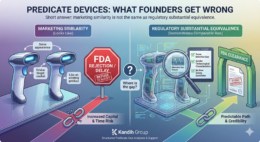
Short answer: marketing similarity is not the same as regulatory substantial equivalence.
Many founders believe that if their device “looks like” something already on the market, they can file a 510(k). That assumption is one of the most common regulatory mistakes in medical device development.
Under the framework of the U.S. Food and Drug Administration, a valid 510(k) depends on proving substantial equivalence—not surface-level similarity.
Those are very different standards.
What Substantial Equivalence Actually Means
To qualify for a 510(k), a device must demonstrate:
The same intended use as the predicate
The same or similar technological characteristics
That any differences do not raise new questions of safety or effectiveness
If technological differences exist, the manufacturer must provide data showing those differences do not increase risk.
This is a structured regulatory comparison—not a branding exercise.
What Founders Often Confuse With Equivalence
1. Similar Target Market
Just because two devices treat the same condition does not mean they share the same intended use.
For example:
A diagnostic device is not equivalent to a monitoring device
A screening tool is not equivalent to a treatment device
A general wellness claim is not equivalent to a clinical claim
Small wording differences in intended use can disqualify a predicate entirely.
2. Similar Appearance or Function
Devices that:
Look alike
Use similar terminology
Serve similar users
may still differ significantly in technological characteristics.
Differences in:
Materials
Software algorithms
Energy sources
Data interpretation
Mechanism of action
can create new safety questions—even if the user experience feels familiar.
FDA evaluates risk, not aesthetics.
3. Similar Marketing Positioning
Marketing claims are not regulatory equivalence arguments.
If your device claims:
Improved performance
Enhanced accuracy
Broader patient population
Expanded indications
you may have introduced new safety or effectiveness questions.
The more differentiation you market, the harder equivalence becomes.
Why This Matters
If substantial equivalence is weak:
FDA may issue additional information requests
The submission may receive a Refuse-to-Accept decision
The pathway may shift to De Novo
Development timelines may extend by 12–24 months
Capital requirements increase
Predicate mistakes rarely fail immediately. They fail under regulatory scrutiny.
What a Strong Predicate Analysis Looks Like
A defensible predicate strategy includes:
Detailed intended use comparison
Line-by-line technological comparison
Risk analysis tied to differences
Data plans addressing identified gaps
Clear justification that no new safety questions are introduced
Anything less is regulatory optimism.
Where Kandih Comes In
This is where Kandih Group performs structured predicate gap analyses.
Kandih supports teams by:
Conducting deep predicate landscape searches
Comparing intended use language precisely
Performing side-by-side technological mapping
Identifying differences that may trigger new safety questions
Assessing whether gaps can be closed with testing
Modeling fallback pathways if equivalence is weak
Instead of assuming a predicate works, founders understand where real regulatory gaps exist.
That prevents:
Weak 510(k) submissions
Unexpected pathway shifts
Investor confidence erosion
Costly rework
Bottom Line
Substantial equivalence is not about looking similar.
It is about demonstrating comparable risk.
Marketing similarity may win customers.
Regulatory equivalence is what wins clearance.
Understanding that difference early protects time, capital, and credibility.
References
FDA – Substantial Equivalence in Premarket Notifications (510(k))
https://www.fda.gov/regulatory-information/search-fda-guidance-documents/substantial-equivalence-premarket-notifications-510k
FDA – Premarket Notification 510(k)
https://www.fda.gov/medical-devices/premarket-submissions/premarket-notification-510k
FDA – Refuse to Accept Policy for 510(k)s
https://www.fda.gov/regulatory-information/search-fda-guidance-documents/refuse-accept-policy-510ks
FDA – Classify Your Medical Device
https://www.fda.gov/medical-devices/overview-device-regulation/classify-your-medical-device