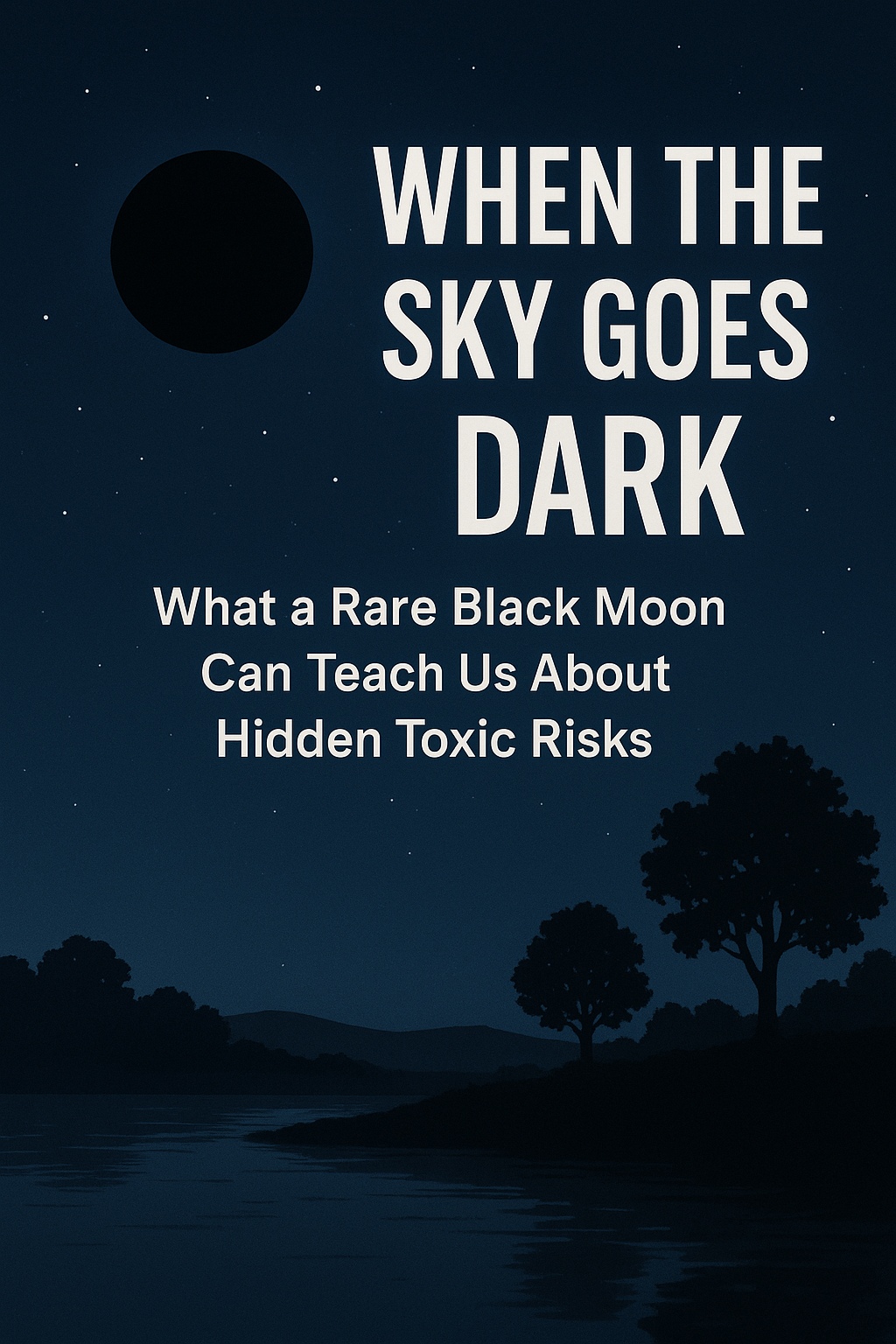
August 24–25, 2025 brought a rare celestial event: a Black Moon—our second new moon in one month, the first in 33 months. Most people didn’t even notice. There was no bright glow, no dramatic eclipse, just darkness. Yet, astronomers know it matters. And that’s the perfect reminder for toxicologists and health professionals: the most important risks are often the ones we can’t see.
The Lesson of the Black Moon
The Black Moon is invisible to the naked eye, yet it sparks global curiosity. In toxicology, our “Black Moons” are hidden hazards—trace amounts of chemicals in water, air, food, or products that can quietly accumulate and cause harm long before symptoms appear.
The parallel is simple but powerful:
Just because you can’t see it doesn’t mean it’s not there.
Just because it’s rare doesn’t mean it’s irrelevant.
Just because people don’t talk about it doesn’t mean it won’t affect them.
Practical Tools to Detect the Invisible
Here’s how toxicologists—and anyone concerned about environmental or chemical health—can learn to “see in the dark”:
Indicator Species
Watch the biological “canaries in the coal mine.” Fish kills, insect die-offs, or shifts in bird migration patterns can all point to contamination.
Sentinel Assays
Lab tests on cells or tissues can flag toxicity before humans ever feel it. Think of these as your early-warning radar.
Analytical Instruments
Gas Chromatography-Mass Spectrometry (GC-MS), Liquid Chromatography (LC-MS), and portable sensors are your telescopes for invisible contaminants. They pick up traces that the human senses never could.
A Real-World Example
In one groundwater monitoring project, standard tests showed “all clear.” But when we dug deeper with targeted mass spectrometry, we picked up low-level lead contamination. Wildlife near the site had subtle behavioral changes—nothing dramatic enough to ring alarm bells. Acting early prevented a community-wide health scare.
That’s toxicology in action: translating subtle, hidden signals into lifesaving interventions.
Engagement Question for You
Think about your own work or environment:
What’s the smallest toxic “signal” you’ve caught that made a big difference?
Drop it in the comments—because the more we share our hidden Black Moons, the better we get at protecting health.
Call to Action
What the Black Moon teaches us is simple but urgent: the invisible matters. Whether you’re a researcher, a health professional, or simply someone who cares about safe air, water, and food—you can learn to spot risks early.
Subscribe here to get my free “5 Toxicology Tactics to Detect Silent Hazards” checklist.
Share this post with someone who still believes, “If I can’t see it, it can’t hurt me.”
Takeaway: Like the Black Moon, toxic risks don’t need to be obvious to be important. The experts who look beyond the visible are the ones who change outcomes.