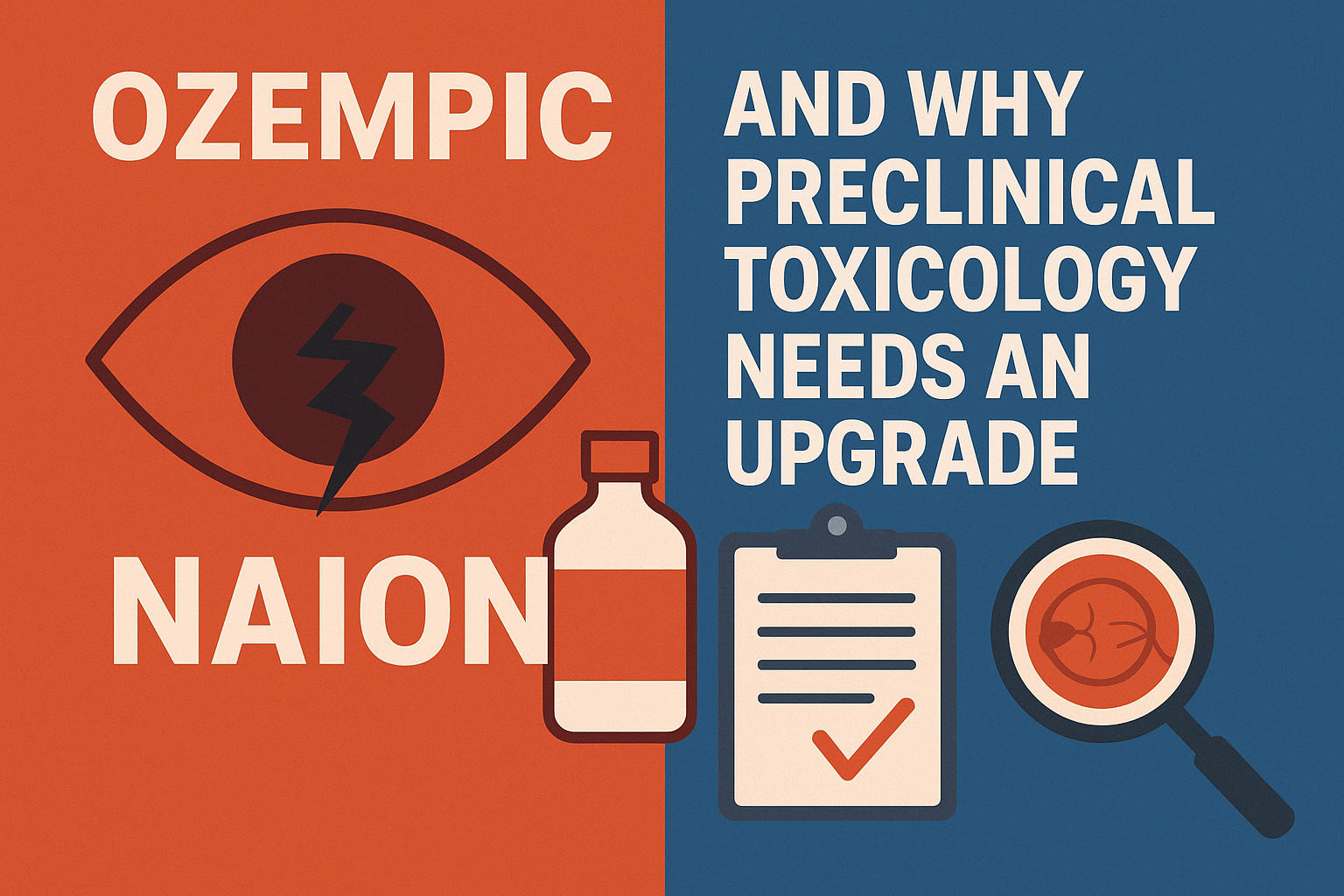
In June 2025, the European Medicines Agency (EMA) confirmed what many clinicians suspected: non-arteritic anterior ischemic optic neuropathy (NAION) is now recognized as a very rare but real side effect of semaglutide (Ozempic).
For patients, this means sudden, irreversible vision loss.
For drug developers, it’s a wake-up call: standard GLP toxicology will almost never catch NAION.
And that blind spot should change how you think about safety in development.
Why NAION Slips Through the Cracks
The problem isn’t that toxicologists miss signals. It’s that the system isn’t built to see them.
Timing: GLP ophthalmic exams are usually spaced out (prior to dosing, prior to main termination and prior to recovery termination). NAION, by contrast, is an acute, transient event—disc edema may last days before collapsing into atrophy. If you only look at Week 13, you miss it.
Endpoints: Routine exams—ERG, funduscopy, histopath—rarely probe the optic nerve head. The real clue would be conduction delays on a VEP (visual evoked potential). But VEP isn’t standard.
Species differences: Rodents and rabbits lack the crowded optic disc anatomy that predisposes humans to NAION. Translation is inherently limited.
Incidence: With NAION rates around 1 in 10,000, a chronic tox study of 20–40 animals is statistically underpowered to detect risk.
Bottom line: GLP tox is too blunt a tool for rare, ischemic optic neuropathies.
What You Can Do as a Developer
This doesn’t mean you’re powerless. It means you need to think tactically.
Know when to add endpoints. If your drug touches vascular, mitochondrial, or ischemic pathways, consider OCT, OCT angiography, and VEP in nonclinical packages. These are sensitive, early indicators of optic nerve compromise.
Listen to clinical signals. Once postmarketing or early trials whisper “optic neuropathy,” regulators expect you to react—strengthen monitoring, acknowledge model limits, and frame a mechanistic story.
Treat PV as a partner, not an afterthought. For rare events like NAION, pharmacovigilance is the safety net. Build it into your strategy, not your crisis response.
Why This Matters
NAION is devastating for patients—and sobering for innovators. It reminds us that even blockbuster drugs like Ozempic can carry rare, vision-threatening risks that preclinical toxicology cannot rule out.
If you’re building the next generation of therapies, here’s the takeaway:
Don’t let GLP tox be your only lens. Pair it with ophthalmology insight, mechanistic context, and strong postmarketing vigilance. That’s how you protect patients—and your program.
Reference:
https://www.ema.europa.eu/en/news/prac-concludes-eye-condition-naion-very-rare-side-effect-semaglutide-medicines-ozempic-rybelsus-wegovy
European Medicines Agency (EMA). Meeting highlights from the Pharmacovigilance Risk Assessment Committee (PRAC), June 2025. EMA confirmed that NAION is a very rare side effect of semaglutide (Ozempic).
Are you developing a therapy with potential vascular or mitochondrial impact? Don’t wait for regulators to raise the red flag. Let’s talk about how to strengthen your safety strategy early—before NAION-like risks derail your program.
Contact us here
[email protected]
240.565.8933
kandih.com