
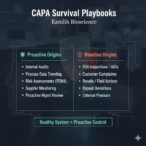
CAPA Survival Playbooks — Kandih Bioscience
CAPAs Don’t Fail at Closure—They Fail at the Source
Most CAPA programs don’t fail because teams can’t write corrective actions.
They fail because organizations never ask—or cannot clearly answer—a far more uncomfortable question:
Where do our CAPAs actually come from?
Inspection after inspection, FDA sees the same pattern: CAPAs are numerous, neatly documented, and technically “closed,” yet the same issues keep resurfacing. Complaints recur. Deviations repeat. Supplier problems persist. Management is surprised—again.
The root problem is not documentation quality.
It is poor signal discipline.
A common misconception is that CAPA success is measured by how efficiently issues are processed and closed. From an inspection standpoint, that metric is meaningless. Inspectors are far more interested in whether CAPAs originate from meaningful risk signals or whether they are reactive paperwork exercises triggered only when problems become impossible to ignore.
This is not abstract quality theory. It is inspection reality. FDA inspectors can quickly tell whether a CAPA system is driven by risk intelligence or compliance anxiety. Where your CAPAs originate—complaints, deviations, suppliers, audits, or FDA findings themselves—tells a clear story about whether the organization is in control or simply responding after the fact.
What FDA Actually Expects: A Regulatory Reality Check
FDA does not evaluate CAPAs as standalone records. Inspectors evaluate the pathways that generate CAPAs and what those pathways reveal about organizational control.
In practice, investigators reverse-engineer the CAPA system. They start with operational signals and trace backward:
Complaints and adverse events
Do trends reliably trigger CAPA when risk thresholds are crossed—or only after external pressure?
Deviations and nonconformances
Are repeat deviations escalated into CAPA, or endlessly treated as isolated events?
Design and process controls
When failures occur, do CAPAs link back to design assumptions, validation strategies, or process capability?
Suppliers and CMOs
Do repeat supplier failures feed CAPA, or are they handled informally through emails and retraining?
Management review
Does leadership identify emerging risks proactively—or do CAPAs only appear once issues are visible to regulators?
Inspectors are not counting how many CAPAs you have. They are assessing whether CAPA triggers align with risk.
A system where CAPAs originate primarily from FDA observations signals reactive management. A system where CAPAs originate from internal trending and cross-functional analysis signals control.
Where CAPAs Commonly Originate—and What That Signals to Inspectors
CAPA origin itself is an inspection datapoint.
1. CAPAs Triggered Primarily by FDA Inspections
Inspection signal: Internal detection mechanisms are weak or ignored. Management relies on FDA to surface systemic risk.
2. CAPAs Driven Almost Exclusively by Complaints
Inspection signal: Risk is being detected late—after product release and potential patient exposure.
3. CAPAs Rarely Triggered by Deviations or Trending
Organizations log hundreds of deviations with minimal escalation.
Inspection signal: Failure is being normalized instead of analyzed.
4. CAPAs Isolated from Supplier and CMO Performance
Repeat supplier issues never rise to CAPA.
Inspection signal: Supplier risk is excluded from the quality system.
5. CAPAs Opened Only After Escalation or Crisis
CAPAs appear suddenly—recalls, field actions, major findings.
Inspection signal: The CAPA system is reactive, not preventive.
Common CAPA Failure Modes That Follow Poor Origination
Once inspectors understand where CAPAs come from, predictable construction failures follow.
1. Weak Root Cause Analysis
Late-origin CAPAs produce narrow, defensive root causes.
Why it fails: Late signals drive containment, not systemic learning.
2. Training-Only or SOP-Only CAPAs
Inspection-triggered CAPAs default to retraining and paperwork.
Why it fails: Inspectors interpret this as avoidance of structural fixes.
3. No Real Effectiveness Verification
CAPAs close quickly to demonstrate responsiveness.
Why it fails: There is no time—or data—to prove sustained control.
4. CAPAs That Don’t Propagate Across Scope
Single-event CAPAs receive minimal scope assessment.
Why it fails: Inspectors expect system-wide thinking.
5. Management Review Without Foresight
CAPAs are reported upward but not used to anticipate risk.
Why it fails: FDA reads this as governance failure, not execution error.
CAPA Closure vs. CAPA Effectiveness: Why Origin Matters
CAPA origin directly shapes CAPA effectiveness.
Administrative closure answers:
Were actions completed?
Were timelines met?
Demonstrated effectiveness answers:
Did the risk stop recurring?
Did related metrics improve over time?
Did the organization learn something repeatable?
Inspectors expect:
Trending data (complaints, deviations, supplier metrics)
Time-based stability (systems must settle)
Risk alignment (verification tied to the original failure mode)
Late-origin CAPAs almost always struggle to show this evidence.
Anonymized Inspection Scenario
An investigator reviewed 18 months of deviation data. Over 200 deviations showed similar process failures. Only one CAPA had been opened—and it followed a recent FDA observation.
Asked why earlier deviations did not trigger CAPA, the firm stated each event was “isolated.” No trending analysis existed.
The observation was not about deviation handling.
It was about failure to use internal data to drive preventive action.
Inspector Red Flags Related to CAPA Origin
Inspectors grow skeptical when they see:
Most CAPAs originate from FDA inspections
Minimal CAPAs from internal trending
Repeated “isolated” deviations
Supplier issues resolved without CAPA escalation
Management review that reports CAPAs but does not generate them
These are signals of a reactive quality system.
What “Good” Looks Like Under Inspection
CAPA systems that hold up share common traits:
Defined escalation thresholds tied to risk
Integrated data review across complaints, deviations, audits, suppliers
Proactive trending that triggers CAPA before external pressure
Cross-functional ownership beyond QA
Management-driven initiation, not just approval
Many organizations benefit from asking quarterly:
Which data sources generated CAPAs?
Which did not—and why?
Were any CAPAs triggered before customer or FDA impact?
What risks are trending without escalation?
Uncomfortable answers usually mean the system is speaking clearly.
Strategic Takeaway
CAPAs tell a story—not just in how they are written, but in where they originate. FDA evaluates CAPA systems as risk-control feedback loops that reveal whether management is leading or reacting.
For organizations preparing for inspection, growth, or due diligence, reviewing CAPA origination patterns through a structured gap analysis or inspection-readiness review can surface vulnerabilities before regulators—or partners—do.
FDA Regulations and Inspection Framework
21 CFR Part 820.100 — Corrective and Preventive Action (Devices)
https://www.ecfr.gov/current/title-21/chapter-I/subchapter-H/part-820/section-820.100
21 CFR Part 211 — Current Good Manufacturing Practice for Finished Pharmaceuticals
https://www.ecfr.gov/current/title-21/chapter-I/subchapter-C/part-211
FDA Compliance Program Guidance Manual (CPGM) 7346.832 — QSIT
Medical Device Quality System Inspection Technique
https://www.fda.gov/media/75394/download
FDA Guidance: Quality Systems Approach to Pharmaceutical CGMP Regulations
https://www.fda.gov/regulatory-information/search-fda-guidance-documents/quality-systems-approach-pharmaceutical-cgmp-regulations
Criticare Technologies, Inc. (2024) — Repeat CAPA system deficiencies
https://www.fda.gov/inspections-compliance-enforcement-and-criminal-investigations/warning-letters/criticare-technologies-inc-686915-07122024
Jiangsu Caina Medical Co., Ltd. (2024) — Failure to analyze quality data sources for CAPA
https://www.fda.gov/inspections-compliance-enforcement-and-criminal-investigations/warning-letters/jiangsu-caina-medical-co-ltd-687033-07182024
GMP Compliance EU — CAPA & Root Cause Analysis Warning Letters
https://www.gmp-compliance.org/gmp-news/four-warning-letter-concerning-capa-and-root-cause-analysis-published
AssurX — CAPA Non-Compliance Warning Letter Trends
https://www.assurx.com/capa-non-compliance-warning-letters/
SciLife — Worst FDA Warning Letters (Pharma CAPA Themes)
https://www.scilife.io/blog/worst-fda-warning-letters-pharma