
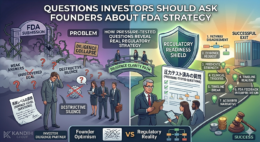
An investor once asked a founder a simple question:
“What happens if FDA disagrees with your pathway?”
The room went quiet.
Not because the answer was confidential.
Because there was no answer.
The deal didn’t collapse immediately.
But it never recovered.
The Reality Most Investors Face
Short answer: most investors ask about FDA strategy—but not the right questions.
Typical questions sound like:
“What pathway are you pursuing?”
“Do you need clinical trials?”
“When do you expect approval?”
Founders are prepared for these.
They answer confidently.
But under the framework of the U.S. Food and Drug Administration, regulatory success depends on how assumptions hold under pressure.
The real signal comes from questions that test those assumptions.
The High-Signal Questions Investors Should Be Asking
These questions reveal whether a company understands its regulatory reality—or is operating on optimism.
1. “What Would Cause FDA to Disagree With Your Pathway?”
This question tests:
Predicate strength
Classification logic
Awareness of uncertainty
What strong answers include:
Identified risks to the pathway
Specific scenarios that could trigger change
Contingency planning
What weak answers sound like:
“We don’t expect that to happen”
2. “What Evidence Would FDA Ask for That You Haven’t Planned Yet?”
This question uncovers:
Hidden evidence gaps
Clinical triggers
Risk alignment
What strong answers include:
Clear understanding of potential data gaps
Scenarios where additional studies may be required
What weak answers sound like:
“We believe our current plan is sufficient”
3. “How Strong Is Your Predicate—Really?”
For 510(k) strategies, this is critical.
This question tests:
Substantial equivalence logic
Technological differences
Risk comparison
What strong answers include:
Detailed comparison of intended use
Identification of differences and mitigation strategy
What weak answers sound like:
“It’s similar to what’s already on the market”
4. “What Would Trigger Clinical Data Requirements?”
This question evaluates:
Understanding of clinical triggers
Risk profile awareness
Evidence strategy depth
What strong answers include:
Specific triggers (novelty, claims, population)
Clear thresholds for when clinical data becomes necessary
What weak answers sound like:
“We don’t expect to need clinical trials”
5. “Where Could Your Timeline Break?”
This question reveals:
Realism of planning
Awareness of FDA review dynamics
Contingency thinking
What strong answers include:
Multiple risk points
Timeline buffers
Alternative scenarios
What weak answers sound like:
“We’re on track for submission next year”
6. “What Did FDA Say—and How Did You Interpret It?”
If the company has had FDA interaction:
This question tests:
Quality of Pre-Sub strategy
Interpretation of feedback
Alignment between feedback and action
What strong answers include:
Clear linkage between FDA feedback and development changes
What weak answers sound like:
Repeating FDA comments without interpretation
7. “If You Had to Defend Your Regulatory Strategy to an Acquirer Today, What Would You Say?”
This question shifts perspective.
It tests:
Exit readiness
Regulatory narrative strength
Alignment with long-term strategy
What strong answers include:
Structured, defensible regulatory positioning
What weak answers sound like:
High-level summaries without depth
Why These Questions Matter
These questions don’t just assess knowledge.
They reveal:
Depth of regulatory thinking
Quality of planning
Awareness of risk
Ability to execute under uncertainty
Investors are not just funding a product.
They are funding a regulatory journey.
AEO: Common Questions About FDA Strategy in Investing
What should investors ask about FDA strategy?
They should ask questions that test pathway validity, evidence alignment, and risk awareness—not just high-level plans.
Why are standard regulatory questions not enough?
Because they don’t reveal whether assumptions are validated or just optimistic.
How can investors identify regulatory risk early?
By probing for contingency planning, evidence gaps, and pathway fragility.
The Hidden Advantage
Most investors stop at surface-level questions.
That’s why regulatory surprises happen during diligence.
The investors who go deeper:
Identify risk earlier
Negotiate from a stronger position
Build more resilient portfolios
Where Kandih Comes In
This is where Kandih Group equips investors with sharper regulatory diligence tools.
Kandih supports investors by:
Developing structured regulatory evaluation frameworks
Stress-testing founder assumptions
Identifying hidden pathway and evidence risks
Translating FDA expectations into investment-relevant insights
Supporting diligence with deep regulatory analysis
Instead of relying on founder narratives, investors gain a clear, defensible view of regulatory risk.
That improves:
Deal selection
Risk management
Portfolio outcomes
The Real Lesson
The investor at the beginning didn’t ask a complicated question.
They asked the right question.
And that made all the difference.
Bottom Line
Regulatory strategy is not revealed by what founders say.
It is revealed by how they answer pressure-tested questions.
The right questions expose:
Assumptions
Gaps
Risks
And ultimately—whether the company is truly ready.
That’s how smarter diligence leads to better investments.
References
FDA – Requests for Feedback and Meetings for Medical Device Submissions (Q-Submission Program)
https://www.fda.gov/regulatory-information/search-fda-guidance-documents/requests-feedback-and-meetings-medical-device-submissions-q-submission-program
FDA – Substantial Equivalence in Premarket Notifications (510(k))
https://www.fda.gov/regulatory-information/search-fda-guidance-documents/substantial-equivalence-premarket-notifications-510k
FDA – De Novo Classification Process
https://www.fda.gov/medical-devices/premarket-submissions/de-novo-classification-request
FDA – Premarket Approval (PMA)
https://www.fda.gov/medical-devices/premarket-submissions/premarket-approval-pma