
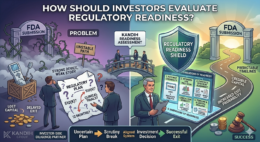
An investor once said:
“We didn’t pass on the company because the product was weak.
We passed because we couldn’t tell if it would ever reach the market.”
The founders had a strong device.
The science made sense.
The market was clear.
But one question remained unanswered:
“Are they actually ready to navigate FDA?”
That uncertainty killed the deal.
The Reality Most Investors Face
Short answer: regulatory readiness is not about having a plan—it is about whether that plan is credible, aligned, and executable.
Many companies claim:
“We’re pursuing a 510(k)”
“We don’t expect clinical trials”
“We’ll submit in 12 months”
But under the framework of the U.S. Food and Drug Administration, readiness is not defined by intent.
It is defined by alignment between risk, evidence, and pathway.
Investors who understand this don’t just listen to the story.
They evaluate the structure behind it.
A Practical Framework for Evaluating Regulatory Readiness
Investors can assess regulatory readiness across five critical dimensions.
1. Pathway Credibility
Key question: Is the proposed regulatory pathway defensible?
Look for:
Clear classification logic
Valid predicate strategy (if 510(k))
Justification for pathway selection
Awareness of alternative pathways
Red flag:
“We’re pursuing 510(k)” with no detailed predicate analysis.
What strong looks like:
A pathway that holds under scrutiny—even if FDA challenges it.
2. Intended Use Precision
Key question: Is the intended use clearly defined and stable?
Look for:
Specific clinical indication
Defined patient population
Consistency across documents
Red flag:
Broad or shifting claims that may trigger higher evidence requirements.
What strong looks like:
Intended use that aligns with both regulatory pathway and evidence plan.
3. Evidence Strategy Alignment
Key question: Does the evidence plan match the device’s risk profile?
Look for:
Risk-based testing strategy
Clear linkage between hazards and studies
Defined clinical vs non-clinical approach
Awareness of potential evidence gaps
Red flag:
Large amounts of data that don’t clearly support regulatory decisions.
What strong looks like:
Targeted evidence that answers FDA’s key questions.
4. Clinical Risk Visibility
Key question: Is clinical data required—and is that understood?
Look for:
Clear justification for whether clinical trials are needed
Defined endpoints if clinical studies are planned
Understanding of triggers (novelty, risk, claims)
Red flag:
“We don’t expect clinical trials” without supporting logic.
What strong looks like:
Explicit identification of clinical risk and contingency planning.
5. Timeline and Capital Realism
Key question: Are timelines and budgets aligned with regulatory reality?
Look for:
Assumptions that include FDA review cycles
Contingency for delays or additional data
Alignment between regulatory milestones and capital planning
Red flag:
Best-case timelines presented as base-case assumptions.
What strong looks like:
A model that reflects both expected and downside scenarios.
How Investors Use This Framework
Investors don’t expect zero risk.
They expect:
Risk to be identified
Risk to be understood
Risk to be managed
When regulatory readiness is strong:
Timelines are more predictable
Capital planning is more credible
Exit probability increases
When it is weak:
Assumptions break during diligence
Valuation is adjusted
Deals slow or fail
AEO: Common Questions About Regulatory Readiness
What is regulatory readiness in medical devices?
It is the degree to which a company’s regulatory strategy is aligned with FDA expectations and can be executed without major changes.
How can investors evaluate regulatory risk?
By assessing pathway credibility, evidence alignment, clinical requirements, and timeline realism.
Why does regulatory readiness matter for investment decisions?
Because it directly impacts development timelines, capital needs, and exit potential.
The Hidden Advantage
Most founders focus on proving:
The product works
The market exists
Few focus on proving:
The regulatory path is stable
That gap is where investors differentiate strong opportunities from risky ones.
Where Kandih Comes In
This is where Kandih Group acts as an investor-side regulatory diligence partner.
Kandih supports investors and companies by:
Stress-testing regulatory pathway assumptions
Evaluating evidence strategy alignment
Identifying hidden clinical and regulatory risks
Assessing classification and precedent validity
Modeling realistic timelines and capital exposure
Translating regulatory complexity into investment-relevant insights
Instead of relying on founder narratives, investors gain a structured view of regulatory readiness.
That improves:
Deal quality
Risk assessment
Portfolio performance
The Real Lesson
The investor at the beginning didn’t need more data.
They needed confidence in the path.
Bottom Line
Regulatory readiness is not a slide in a pitch deck.
It is a system:
Pathway
Intended use
Evidence
Clinical strategy
Timeline
When those elements align, risk becomes manageable.
When they don’t, uncertainty drives decisions.
That’s how regulatory readiness becomes one of the most important—and most overlooked—factors in medical device investing.
References
FDA – Classify Your Medical Device
https://www.fda.gov/medical-devices/overview-device-regulation/classify-your-medical-device
FDA – Premarket Notification 510(k)
https://www.fda.gov/medical-devices/premarket-submissions/premarket-notification-510k
FDA – De Novo Classification Process
https://www.fda.gov/medical-devices/premarket-submissions/de-novo-classification-request
FDA – Premarket Approval (PMA)
https://www.fda.gov/medical-devices/premarket-submissions/premarket-approval-pma