
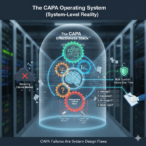
The CAPA Operating System (System-Level Reality) Most CAPA programs don’t fail because of weak documentation.They fail because they were never architected as systems. Organizations routinely design CAPA as a QA artifact—a form, a workflow, a closure event. FDA inspects something very different: a live, end-to-end risk-control system that proves an organization can detect, absorb, and […]
Category: Uncategorized

Disseminated Intravascular Coagulation – Causes
DIC is caused by another medical condition that makes the body’s normal blood clotting process become overactive. The condition progresses through two stages. In the early stages, overactive clotting leads to blood clots throughout the blood vessels. The clots can reduce or block blood flow, damaging organs.
As DIC progresses, the overactive clotting uses up platelets and clotting factors, which are protein that help with normal blood clotting. Without these platelets and clotting factors, DIC can cause bleeding just beneath the skin, in the nose or mouth, or deep inside the body
Fifty Salmonella Recalls Later: What the Frozen Food Industry Still Isn’t Getting About Safety
A Toxicologist’s Take on Why This Was Predictable—and Preventable
According to NewsNation, a New Jersey–based frozen food distributor has issued more than 50 recall notices after multiple products were linked to Salmonella contamination. The scope is extraordinary: dozens of products, multiple brands, nationwide distribution, and exposure across vulnerable populations.
(Source: NewsNation, 2025)
This is not just another recall story.

Baycol (Cerivastatin): The Statin That Taught Pharma a Billion-Dollar Toxicology Lesson
How Muscle Toxicity, Drug Interactions, and Design Blind Spots Led to a Global Withdrawal
In 2001, Bayer withdrew cerivastatin—marketed as Baycol in the U.S. and Lipobay internationally—after mounting reports of rhabdomyolysis, a severe form of muscle breakdown that can lead to acute renal failure and death.
The consequences were immediate and severe: a global recall, thousands of adverse event reports, over 50 confirmed deaths, multibillion-dollar litigation settlements, and long-term reputational damage that weighed heavily on Bayer’s valuation for years.

FDA Announces Nationwide Recall of Nasal Spray Due to Bacterial Contamination — A Toxicology and Product Development Wake-Up Call
The FDA has announced a nationwide recall of a widely used over-the-counter nasal spray after testing revealed contamination with pathogenic bacteria capable of causing serious infections. The recall followed multiple reports of sinus infections and systemic illness linked to the affected lots.Source: Health.com (2025) https://www.health.com/nasal-spray-recall-december-2025-11868374 This isn’t just a manufacturing lapse. It is a toxicology […]
Vioxx: The $30B Toxicology Lesson Pharma Can’t Afford to Forget
According to MDLinx, Rofecoxib (Vioxx) — Merck’s blockbuster COX-2 selective anti-inflammatory drug — was withdrawn in 2004 after long-term clinical data revealed a significant increase in heart attack and stroke risk.
This single mechanistic toxicology failure erased more than $30 billion in market value, triggered historic litigation, and permanently reshaped FDA’s cardiovascular risk requirements.
Rezulin and the Toxicology Lessons We Still Haven’t Learned
How Troglitazone’s Hepatotoxicity Changed Drug Development Forever — and Why It Still Matters Today
Troglitazone (Rezulin), introduced by Warner-Lambert and later absorbed by Pfizer, was once celebrated as a breakthrough insulin-sensitizing therapy for type 2 diabetes. Within a few years, it became one of the most catastrophic toxicology failures in FDA history — linked to idiosyncratic yet sometimes fatal liver injury, multiple cases of acute liver failure, and a full U.S. market withdrawal in 2000.
High Blood Pressure Medication Voluntarily Recalled — What Toxicologists Saw Coming
According to The Hill, a widely used high-blood-pressure medication was voluntarily recalled after FDA testing identified contamination and quality issues that could pose serious risks to patients.
https://thehill.com/policy/healthcare/5636604-high-blood-pressure-medication-voluntarily-recalled-fda
Why do these recalls keep happening?
Because wherever chemistry, manufacturing, and patient exposure intersect — toxicology decides the outcome.
Here’s the one idea you should take away:

Heart-Healthy Living – Get Your Blood Pressure and Cholesterol Checked
Two of the major risk factors for heart disease are high blood pressure and high blood cholesterol. If either of these numbers is high, work with your doctor to get it to a healthy range.