
CAPA Survival Playbooks — Kandih Bioscience
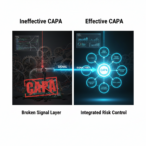
If your CAPA depends on complaints—but your complaint handling system is weak—your CAPA is already dead.
From an FDA inspection perspective, complaints are not paperwork to close. They are early-warning signals that feed the CAPA risk-control loop. When complaint signals are distorted, minimized, or inconsistently escalated, CAPA operates on corrupted data and fails—regardless of documentation quality.
The Wrong Assumption (Let’s Kill It First)
Assumption:
“Once we log, investigate, and close the complaint, CAPA will take care of the rest.”
FDA reality:
Complaints are not events. They are inputs to a system.
The U.S. Food and Drug Administration does not evaluate complaint files in isolation. Inspectors evaluate whether your complaint → CAPA risk loop can reliably detect, interpret, and control product and patient risk over time.
If the input signal is weak, CAPA never had a chance.
What FDA Is Actually Evaluating
From an inspector’s perspective, complaint handling answers three questions:
Do you see risk early enough?
Do you interpret complaint data correctly across the system?
Do complaints reliably trigger meaningful CAPA when warranted?
When complaint handling fails, FDA doesn’t see “documentation gaps.”
FDA sees loss of signal fidelity—and that is a system-level quality failure.
The 5 Complaint Handling Errors That Kill CAPAs
1. Treating Complaints as Isolated Events
System failure: Broken Signal Layer
Complaints are investigated one-by-one, detached from trends, recurrence, severity distribution, or use conditions.
FDA interpretation:
One complaint is noise. Trends are signal. If you cannot trend by failure mode, population, severity, or use environment, FDA assumes you are missing systemic risk.
Why this kills CAPA:
The signal never consolidates, so CAPA is triggered too late—or not at all.
2. Premature MDR Triage That Minimizes Risk
System failure: Distorted Causality Layer
Investigations are framed around “Is this reportable?” instead of “What does this failure mode mean?”
FDA interpretation:
You are optimizing for regulatory avoidance, not risk understanding. Inspectors routinely cross-walk complaint narratives against MDR decisions to detect bias.
Why this kills CAPA:
Risk is narrowly framed to avoid escalation, so CAPA—if opened—is under-scoped from the start.
3. Root Cause Stops at “User Error”
System failure: Collapsed Causality Layer
“Use error,” “misuse,” or “off-label use” becomes the terminal root cause.
FDA interpretation:
Human behavior is not a root cause; it is an interface. FDA expects evaluation of design, labeling, training adequacy, detection controls, and foreseeable misuse.
Why this kills CAPA:
The system is never changed. Training becomes the default action. Recurrence is guaranteed.
4. CAPA Trigger Logic Is Inconsistent or Subjective
System failure: Broken Control Layer
CAPA initiation depends on who reviews the complaint, workload, or discomfort with escalation.
FDA interpretation:
Your CAPA system is discretionary, not risk-based. That signals weak governance and unreliable control.
Why this kills CAPA:
Similar complaints lead to different outcomes. FDA reads that as lack of control—not flexibility.
5. Complaint Closure ≠ CAPA Effectiveness
System failure: Missing Verification Layer
Complaint closed. CAPA closed. No evidence that:
the failure mode declined
severity shifted
detection improved
FDA interpretation:
Administrative closure without outcome evidence equals ineffective CAPA. Inspectors explicitly look for post-CAPA complaint trends.
Why this kills CAPA:
You cannot demonstrate durable risk control. Repeat findings become inevitable.
The FDA Logic (Uncomfortable, but Predictable)
From FDA’s standpoint:
Complaints are leading indicators of patient risk
CAPA is the system response to that indicator
If complaints don’t reliably shape CAPA, the quality system is decorative
This is why complaint handling failures routinely appear upstream of CAPA observations in FDA inspections and Warning Letters.
The Design Principle (Your One Takeaway)
Design complaint handling as a signal-processing system—not a case-management function.
Your complaint system should be able to answer, clearly and with data:
What risk is emerging?
How do we know it’s systemic?
Why did it trigger—or not trigger—CAPA?
How did CAPA measurably change complaint behavior?
If it cannot, CAPA is operating on corrupted input.
FAQ
Q: Why does FDA care so much about complaint handling in CAPA?
A: Because complaints are early indicators of patient and product risk. If complaint data is weak, CAPA cannot control risk effectively.
Q: Can a closed complaint still require CAPA?
A: Yes. FDA expects complaint trends—not individual closure—to drive CAPA initiation.
Q: Is “user error” an acceptable root cause?
A: Rarely by itself. FDA expects analysis of design, labeling, training, and foreseeable misuse.
Q: Does FDA check complaint trends after CAPA closure?
A: Explicitly. Post-CAPA complaint behavior is a primary effectiveness indicator.
If your complaint handling process cannot explain itself end-to-end to an FDA inspector without narrative gymnastics, it is not designed yet.
That is where diagnostic audits, CAPA remediation, and system-level redesign—not procedural patching—actually matter.
References (Primary, FDA-Authoritative)
U.S. Food and Drug Administration — 21 CFR 820.198 (Complaint Files)
FDA requirements for complaint handling, evaluation, investigation, MDR assessment, and linkage to CAPA.
https://www.ecfr.gov/current/title-21/chapter-I/subchapter-H/part-820/section-820.198
U.S. Food and Drug Administration — 21 CFR 820.100 (Corrective and Preventive Action)
Establishes CAPA as a system requiring investigation, root cause, corrective action, verification, and management review—not paperwork closure.
https://www.ecfr.gov/current/title-21/chapter-I/subchapter-H/part-820/section-820.100
U.S. Food and Drug Administration — Medical Device Reporting (21 CFR Part 803)
Defines MDR decision-making and FDA’s expectations for complaint evaluation versus reportability—often cross-checked during inspections.
https://www.ecfr.gov/current/title-21/chapter-I/subchapter-H/part-803
U.S. Food and Drug Administration — QSIT Inspection Technique Guide
Describes how FDA investigators trace complaints, trends, and failures through CAPA to assess systemic effectiveness.
https://www.fda.gov/media/75329/download
U.S. Food and Drug Administration — Quality System Regulation Preamble (1996)
Explains FDA’s intent that complaint handling and CAPA operate as integrated risk-control mechanisms.
https://www.fda.gov/media/71023/download
International Council for Harmonisation — Pharmaceutical Quality System
Positions complaint data and CAPA as feedback mechanisms for management responsibility and continual improvement.
https://database.ich.org/sites/default/files/Q10%20Guideline.pdf
International Council for Harmonisation (R1) — Quality Risk Management
Provides the risk-based principles FDA expects firms to apply when interpreting complaint trends and triggering CAPA.
https://database.ich.org/sites/default/files/ICH_Q9R1_Guideline_2023.pdf
ISO 13485:2016 — Medical Devices QMS
Aligns complaint handling, CAPA initiation, and effectiveness verification within a risk-based quality framework.
https://www.iso.org/standard/59752.html
FDA Warning Letter Database — CAPA & Complaint Trends
Public enforcement actions repeatedly cite complaint handling failures upstream of ineffective CAPA.