
CAPA Survival Playbooks — Kandih Bioscience
CAPA does not sit in QA.
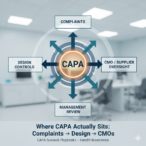
From an FDA inspection perspective, CAPA sits at the intersection of complaints, design controls, supplier/CMO oversight, and management review. If CAPA is positioned downstream—after complaints are closed, designs are frozen, or suppliers are “handled”—inspectors interpret the system as reactive and ineffective, regardless of documentation quality.
Why “Clean” CAPAs Still Fail FDA Inspections
Most CAPA programs fail in the same quiet way:
they are managed vertically while risk moves horizontally.
Complaints → postmarket
Design issues → R&D
Supplier problems → procurement
CAPA → QA
Each function may be compliant in isolation. During inspection, however, the U.S. Food and Drug Administration connects those systems in minutes. If CAPA does not bridge them, the system collapses under questioning.
Key inspection reality:
CAPA is not what you do after containment.
CAPA is where signals force system-level interrogation and correction.
Where FDA Expects CAPA to Sit (Inspection Logic)
Inspectors do not audit CAPA forms first.
They start with signals, then trace risk across systems.
Typical FDA Signal Entry Points
Complaint trends
Repeat deviations or nonconformances
Adverse trends at CMOs or suppliers
Design-related failure modes reappearing postmarket
Inspector Follow-Up Questions
Did complaints escalate into CAPA early and risk-based?
Did CAPA drive design control review, not just fixes?
Were CMOs/suppliers evaluated as part of the CAPA scope?
Did management act on trends before FDA identified them?
Inspection takeaway:
CAPA is a risk-control junction, not an endpoint.
Common FDA-Observed CAPA Failure Modes (By Placement Error)
1. Complaints Are Contained, Not Interpreted
CAPA opens only after complaint thresholds are exceeded.
Why FDA objects:
Complaints are early-warning signals, not clerical events.
2. CAPA Stops Short of Design Controls
Manufacturing fixes implemented without reassessing design assumptions, risk files, or usability.
Why FDA objects:
CAPA must challenge whether the product was designed to perform reliably in real-world conditions.
3. Supplier / CMO Issues Stay Local
Nonconformances resolved at the site without CAPA propagation into qualification, oversight, or quality agreements.
Why FDA objects:
CMOs are extensions of your quality system. Risk does not stop at the contract boundary.
4. Root Cause Mirrors Org Charts
“Manufacturing error,” “supplier issue,” or “user misuse” aligns neatly with departmental ownership.
Why FDA objects:
Organizational silos are not root causes.
5. Management Review Is Passive
CAPA trends are reported, but decisions, prioritization, and resourcing are invisible.
Why FDA objects:
Awareness without action equals loss of management control.
CAPA Closure vs. CAPA Effectiveness (What FDA Actually Cares About)
Administrative Closure Shows:
Tasks completed
Documents signed
Timelines met
CAPA Effectiveness Shows:
Complaint rates tied to the failure mode declined
Design or process changes altered performance metrics
Supplier variability reduced and sustained
The system behaves differently under stress
FDA expects evidence of:
Time (post-implementation stability)
Data (trend analysis tied to the original risk)
Scope (related products, processes, and CMOs evaluated)
A CAPA that sits downstream of complaints cannot meet these expectations.
Business and Regulatory Impact of Misplaced CAPA
Regulatory: Form 483s, warning letters, broader inspection scope
Operational: Repeat failures, CMO disruptions, supply instability
Strategic: Erosion of FDA confidence across programs
Financial: Delayed approvals, remediation costs, valuation risk
FDA reads repeated CAPA failures as evidence that management cannot see—or control—risk across boundaries.
So do investors and acquirers.
Anonymized FDA Inspection Scenario
Complaints showed performance variability
CAPA implemented manufacturing fixes at one CMO
Effectiveness evidence = improved yield
FDA follow-up:
Were design tolerances reassessed?
Were other CMOs evaluated?
They were not.
Result: CAPA closed administratively, deemed ineffective systemically.
Inspector Red Flags (Fast Scan)
FDA inspectors get skeptical when they see:
Complaint trends that never trigger design review
CAPAs that stop at manufacturing for design-linked failures
Supplier issues fixed locally without governance changes
Effectiveness checks limited to one site
Management reviews with no visible decisions
These are structural failures—not paperwork gaps.
What “Good” Looks Like to FDA
Effective CAPA systems sit where risk lives, not where paperwork ends.
Practically:
Complaints escalate into CAPA early, with defined thresholds
Design controls are routinely challenged when performance is implicated
CMO and supplier oversight is integrated and risk-based
Cross-functional ownership replaces silos
Effectiveness verification spans products, sites, and time
Simple Internal CAPA Positioning Test
What system detected the signal?
What upstream systems influence recurrence?
What downstream systems confirm control?
Who at management level owns residual risk?
If CAPA cannot answer these with evidence, it is positioned incorrectly.
FAQ
Q: Where should CAPA sit in a quality system?
A: CAPA should sit at the intersection of complaints, design controls, supplier/CMO oversight, and management review—not solely within QA.
Q: Why do FDA inspectors reject “clean” CAPAs?
A: Because clean documentation does not prove risk control, learning, or sustained effectiveness across systems.
Q: Does CAPA need to involve design controls?
A: Yes—when complaints or failures implicate performance, usability, or assumptions, FDA expects design review as part of CAPA.
Q: Are CMOs part of CAPA scope?
A: Always. FDA views CMOs as extensions of the manufacturer’s quality system.
Strategic Takeaway
CAPA does not live in QA.
It lives where complaints challenge design, where suppliers test governance, and where management proves control.
FDA evaluates CAPA effectiveness by following risk across systems, not by reading forms.
For organizations preparing for inspection, growth, or due diligence, a CAPA linkage review across complaints, design controls, and CMOs will surface systemic gaps early—before regulators or partners do.
References:
U.S. Food and Drug Administration (FDA)
21 CFR 820.100 — Corrective and Preventive Action (CAPA)
Establishes CAPA as a system requiring investigation, analysis of quality data sources, systemic corrective action, and effectiveness verification—not downstream documentation.
https://www.ecfr.gov/current/title-21/chapter-I/subchapter-H/part-820/subpart-J/section-820.100
U.S. Food and Drug Administration (FDA)
Quality System Inspection Technique (QSIT) Guide
Describes how FDA investigators trace signals (complaints, nonconformances, supplier issues) through CAPA to assess systemic control.
https://www.fda.gov/media/73589/download
FDA Warning Letter — Criticare Technologies, Inc. (July 12, 2024)
Illustrates failure of CAPA to identify root cause, implement systemic action, and verify effectiveness; explicitly framed as a repeat CAPA system deficiency.
FDA Warning Letter — Jiangsu Caina Medical Co., Ltd. (July 18, 2024)
Demonstrates failure to analyze quality data sources to identify causes of nonconforming product under 21 CFR 820.100(a)(1).
FDA Warning Letter — Contec Medical Systems Co., Ltd. (Oct 2, 2025)
Highlights CAPA closure without documented completion of preventive actions and inadequate investigation—classic verification and governance failure.