
By Kandih Bioscience • Biocompatibility Strategy Series
From r/AskEngineers: “We’re using a USP Class VI rated polymer for our implantable device. Our supplier says it’s already been tested and it’s safe. Our regulatory consultant says we still need ISO 10993 testing. Who’s right? Feels like we’re being asked to pay for testing we already paid for.”
The regulatory consultant is right. The supplier isn’t wrong either. They’re just answering different questions — and that gap is costing implant companies months of submission delays every single year.
USP Class VI is one of the most widely misunderstood certifications in medical device materials. It sounds authoritative. It’s on the supplier’s data sheet. Engineers see it and feel like a box is checked. Regulatory teams see it and know the work is just beginning.
This piece is about that gap. What USP Class VI actually tests, what it doesn’t, and why FDA — for an implantable device — is going to ask for a lot more before your submission goes anywhere.
If you’re a founder building an implantable or long-term contact device, or an investor trying to read the regulatory maturity of a device company, this is the conversation that determines whether a submission is ready or six months away from ready.
What USP Class VI Actually Tests
USP Class VI is a plastics testing standard from the United States Pharmacopeia. It was originally designed for pharmaceutical containers and closures — packaging that holds drugs, not devices that go inside people.
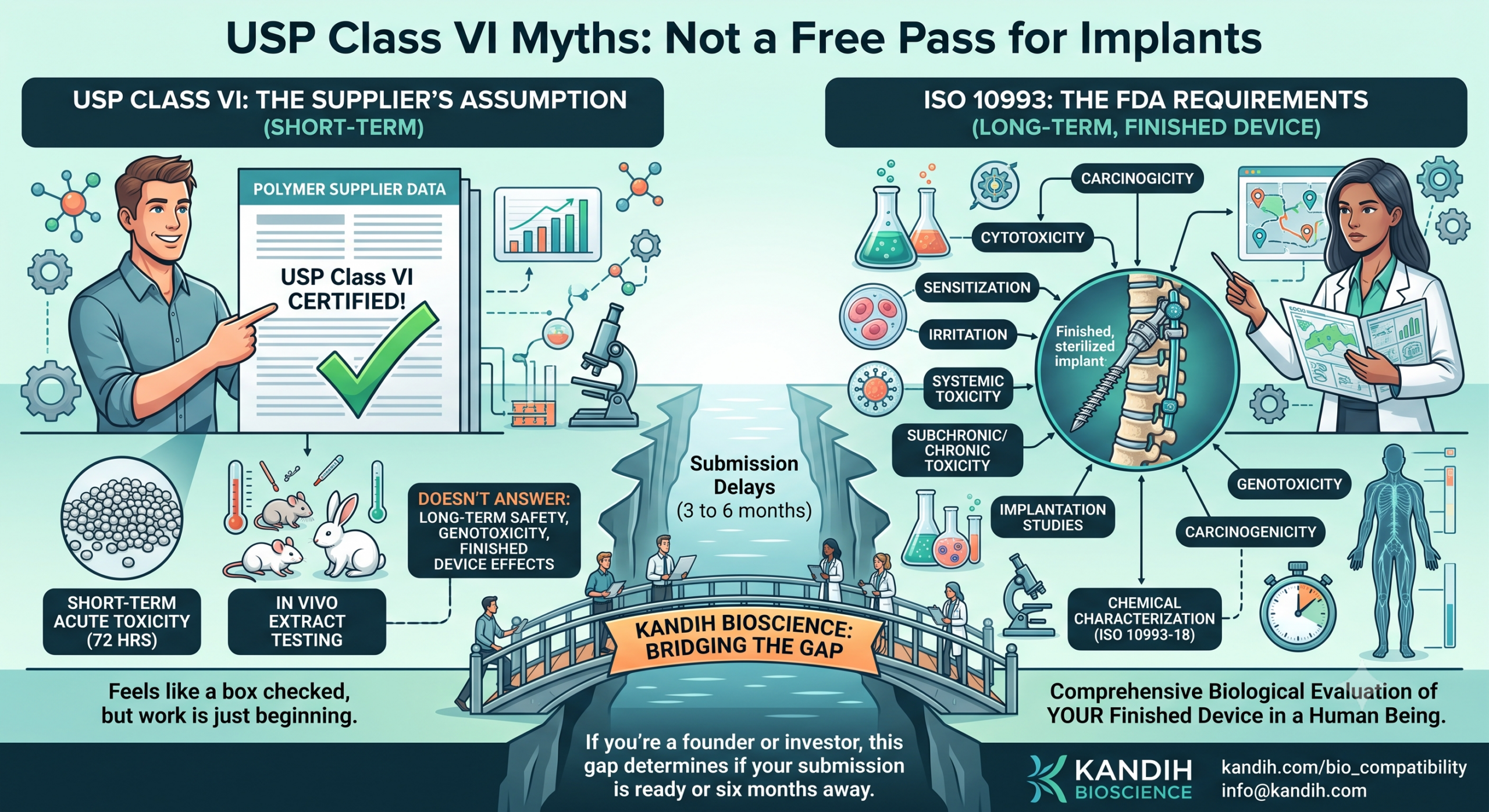
The test involves exposing a material to three different types of extraction fluids at elevated temperatures, then injecting those extracts into mice and rabbits and watching for acute toxic reactions. If none of the animals show a significant response within 72 hours, the material passes.
That’s it.
USP Class VI tells you that the material’s extractables — in three specific fluids, at elevated temperatures, over a short extraction window — didn’t cause acute toxicity in a small animal model.
Here is what it doesn’t tell you:
- Whether the material causes cell death in human tissue on direct contact
- Whether it triggers sensitization or an immune response with prolonged exposure
- Whether it causes localized tissue inflammation or damage at an implant site
- Whether chemicals leach from it over weeks or months inside the body under realistic physiological conditions
- Whether it causes genotoxic or carcinogenic effects with long-term implantation
- Whether it behaves the same way in your specific device geometry, with your specific sterilization method, in your specific patient population
None of those questions are answered by a USP Class VI certification. All of them are questions FDA will ask before clearing an implantable device.
USP Class VI is a short-term animal study on raw material extracts. ISO 10993 is a comprehensive biological evaluation of your finished device as it will be used in a human being. They are not the same test. One does not substitute for the other.
Why the Confusion Happens
The confusion is understandable. Here’s why it keeps happening.
First, USP Class VI sounds comprehensive. The Roman numeral, the word ‘Class,’ the fact that it appears on an official supplier data sheet — all of it signals rigor. Engineers working with materials for the first time often assume that a certified material is a cleared material.
Second, suppliers have a commercial reason to highlight it. ‘USP Class VI Compliant’ on a data sheet is a selling point. It tells the buyer: this material was tested. What it doesn’t say — and what no data sheet will volunteer — is what exactly was tested and what wasn’t.
Third, the standard itself is old. USP Class VI was developed decades before the modern ISO 10993 framework. It was never intended to be a biocompatibility standard for implantable devices. It got adopted into that role informally, and the misconception stuck.
FDA has been clear about this for years. Their guidance on ISO 10993-1 specifically notes that USP Class VI testing alone is not sufficient for most device applications — and for implantable devices, it is nowhere near sufficient.
For investors: if a company’s biocompatibility strategy for an implantable device rests primarily on USP Class VI certification from a material supplier, that’s a substantive gap — not a paperwork issue. The additional testing required can take 3 to 6 months and meaningful budget to complete. If it hasn’t started, the submission timeline hasn’t started either.
What FDA Actually Requires for an Implantable Device
For a device with permanent or long-term implant contact — defined as more than 30 days inside the body — FDA’s biocompatibility requirements are among the most demanding in the device space.
Under ISO 10993-1, the applicable endpoint categories for a long-term implant typically include:
- Cytotoxicity — does the material damage or kill human cells on direct contact?
- Sensitization — does repeated or prolonged exposure trigger an allergic immune response?
- Irritation and intracutaneous reactivity — does the material cause local tissue inflammation?
- Systemic acute toxicity — can absorbed substances cause broader organ-level effects?
- Subchronic and chronic toxicity — what happens with sustained chemical exposure over weeks or months?
- Implantation — what is the local tissue response at the site where the device sits?
- Genotoxicity — does the material cause genetic damage that could lead to cancer or heritable effects?
- Carcinogenicity — for long-term implants, is there evidence the material could promote tumor growth?
- Reproductive and developmental toxicity — depending on the patient population
On top of those biological endpoint tests, FDA also expects a chemical characterization study under ISO 10993-18 — a detailed analysis of what chemicals could actually leach from your specific device under real physiological conditions.
That chemical characterization study is device-specific. It depends on your actual material, your actual device geometry, your sterilization process, and the physiological environment the device will sit in. A supplier’s data sheet, no matter how thorough, cannot produce that data for you.
USP Class VI appears nowhere in that list. It can sometimes contribute as a supporting data point in a broader chemical characterization argument. It cannot anchor the biocompatibility strategy for an implantable device.
The Three Assumptions That Set Teams Back the Most
After working through biocompatibility strategies with implant companies, the same misconceptions appear. They’re not signs of carelessness. They’re signs of a field where the standards are genuinely confusing and where supplier certifications look more complete than they are.
Assumption 1: The supplier tested it, so we don’t have to.
The supplier tested their raw material. You are building a finished device. The finished device has a specific shape, a specific surface area, a specific sterilization history, and a specific use environment. The biological behavior of a finished implant is not identical to the biological behavior of a raw polymer pellet.
ISO 10993 requires evaluation of the finished device — or a representative sample of it — not the raw material alone. That work belongs to the device manufacturer, not the material supplier.
Assumption 2: We changed to a Class VI-rated material, so our biocompatibility data still applies.
If you switch materials — even to a material with a stronger certification profile than the original — your existing biocompatibility data may no longer cover the device. Different materials have different extractable chemical profiles. A new material needs to be characterized under ISO 10993-18, and the relevant biological endpoints need to be re-evaluated or justified.
The certification on the new material doesn’t transfer the testing record from the old one.
Assumption 3: We can add the biocompatibility data later.
Implant biocompatibility testing — particularly chronic toxicity, implantation studies, and carcinogenicity studies — takes time. Some of these studies run for months. You cannot run them in parallel with a submission review. They have to be complete before you submit.
Companies that discover this assumption late end up with a submission that can’t move until studies they haven’t started are finished. That’s not a minor delay. That’s a fundamental roadblock.
Founders: the cost of starting implant biocompatibility testing at the beginning of development is measured in weeks of lead time and a testing budget. The cost of starting it six months before your planned submission date is measured in the months you’ll have to push the submission back. Start it early.
How to Read a Material Data Sheet the Right Way
Not everything on a supplier’s data sheet is useless for your biocompatibility file. Knowing what to use and what to put in context is how you avoid both the false security problem and the duplicate-testing problem.
Here’s how to read the certification claims:
- USP Class VI: useful as a supporting data point in your chemical characterization argument. It tells you the material’s acute extractable profile was evaluated. It does not replace device-level testing.
- ISO 10993-5 (cytotoxicity) on the raw material: potentially supportive if the test conditions and material lot match your device. Not automatically transferable — needs to be evaluated against your specific device configuration.
- RoHS or REACH compliance: regulatory frameworks for hazardous substances in electronics and chemicals. Useful for supply chain compliance. Not biocompatibility evidence.
- FDA Drug Master File (DMF) reference: indicates the material has been reviewed in the context of a drug application. Not the same as device biocompatibility clearance.
The right approach isn’t to ignore supplier data. It’s to use it correctly — as supporting context within a device-level biological evaluation, not as a substitute for one.
Where Kandih Bioscience Comes In
The USP Class VI misconception is one of the most common starting-point errors we see in implant biocompatibility strategy. It’s not a sign that a team doesn’t care about safety. It’s a sign that the space between ‘the material is certified’ and ‘the device is cleared’ is genuinely confusing — and that supplier data sheets don’t explain the gap.
At Kandih Bioscience, we work with implant and long-term contact device companies to build biocompatibility strategies that FDA will actually accept. That means:
- Reviewing your material data sheets and certifications to identify what they support, what they don’t, and what additional testing is needed to close the gap
- Building a biological evaluation plan that maps your specific device — material, geometry, sterilization method, contact duration, patient population — to the correct ISO 10993 endpoints
- Designing a chemical characterization study under ISO 10993-18 that reflects your finished device, not just your raw material
- Identifying which studies can be supported by existing data and which ones require new testing — so you’re not paying for tests you don’t need or skipping ones you do
- Preparing a biological evaluation report that integrates your testing, your supplier data, and your risk rationale into a submission-ready package
If you’re a founder who has been told your material is ‘already tested’ and you’re not sure what that actually means for your submission, that’s exactly the conversation we have with teams every week.
If you’re an investor trying to understand whether a device company’s biocompatibility documentation is submission-ready or six months away from it, we can give you a plain-language answer.
→ Book a Biocompatibility Review: kandih.com/bio_compatibility
Contact Kandih Bioscience • [email protected] • kandih.com • 240.565.8933
References
1. FDA — Use of International Standard ISO 10993-1: Biological Evaluation of Medical Devices (2020)
4. United States Pharmacopeia — USP <88> Biological Reactivity Tests, In Vivo: Class VI Plastics (current)
5. FDA — Biocompatibility of Medical Devices: Overview and FDA’s Approach (2021)
7. ISO — ISO 10993-6: Tests for Local Effects After Implantation (2016)