
Small teams can clear 510(k)s. But not the same way large companies do. Here’s what’s different — and where the gaps usually show up.
By Kandih Bioscience • 510(k) Strategy Series
From r/FDA510kSupport: “It’s just me and two engineers. We’ve been working on this device for three years and we’re finally close to submitting. But every time I dig into the 510(k) requirements, I find another section I don’t fully understand. Is there a checklist somewhere that actually explains what FDA wants? Not just what sections to fill in — what they actually want to see?”
There’s no single checklist. But there are patterns. And after working with small teams through 510(k) submissions across device categories, the same sections show up as the hardest ones — not because they’re the most technically demanding, but because they require a type of documentation that small engineering teams rarely generate naturally.
This is a plain-language walk through those sections, what FDA is actually looking for in each one, and where small teams most often need outside help to fill the gap.
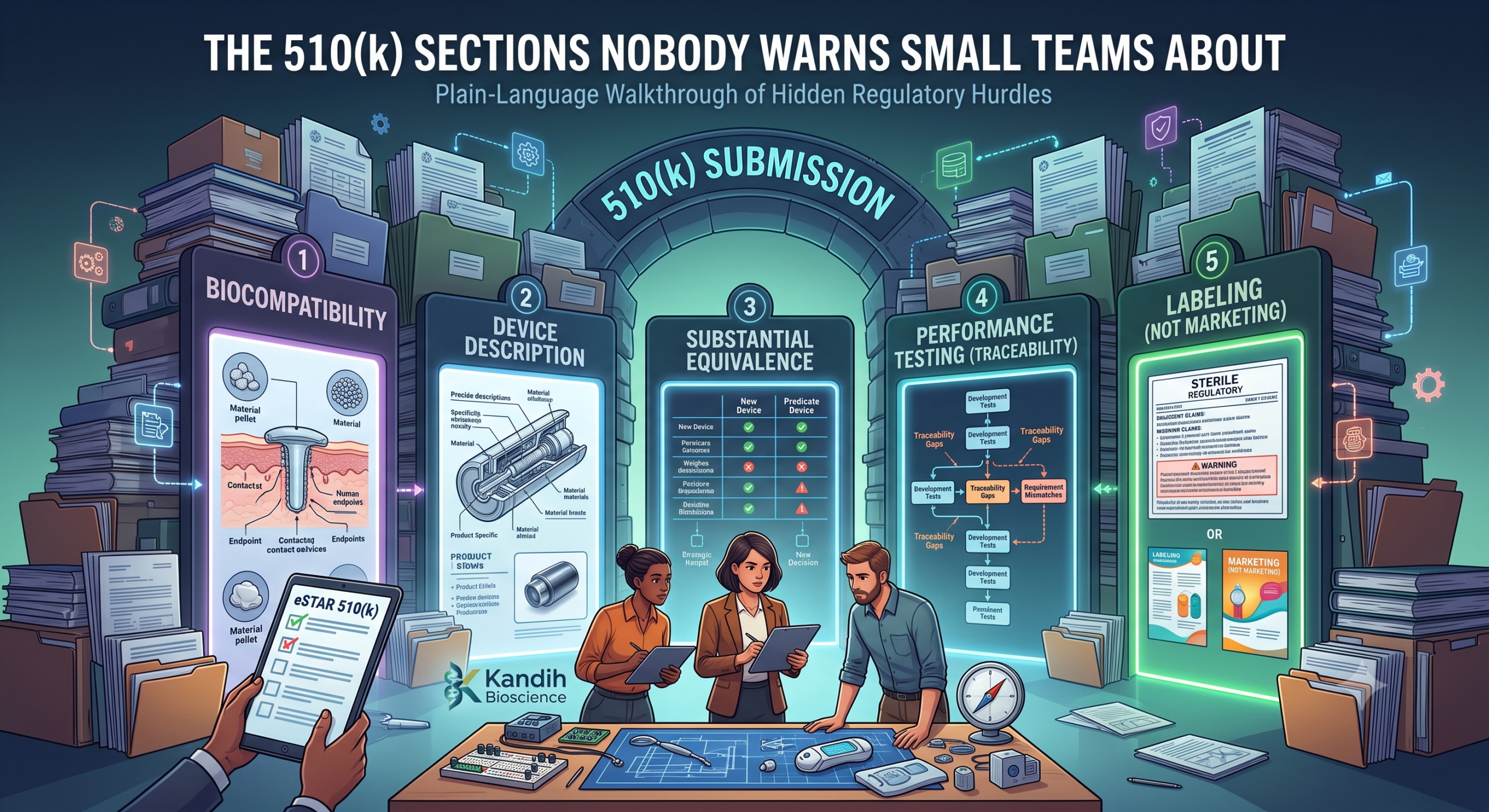
Section 1: Biocompatibility — The One That Surprises Almost Everyone
Small teams almost always underestimate this section.
The eSTAR template makes it look like a checkbox: confirm that biocompatibility testing was conducted. What FDA reviewers actually evaluate is a biological evaluation report that walks through every applicable testing endpoint for your specific device — based on how it contacts the body, for how long, and in what context.
For a device with sustained skin contact, you may need cytotoxicity, sensitization, and irritation testing at minimum. For a device with blood contact or implant contact, the endpoint list gets longer and the testing gets more expensive and time-consuming.
The most common small-team mistake: submitting a material supplier’s certificate or a USP Class VI rating in place of device-level biocompatibility testing. These are not the same thing. FDA will ask for the device-level data.
The second most common mistake: testing was done on prototype materials, not the final production device. If your materials, supplier, or manufacturing process changed after testing, the data may not cover what’s actually being submitted.
If you have one section to get external help on before you submit, it’s this one. A biocompatibility gap is the most common trigger for a major deficiency letter and the most expensive one to fix after the fact.
Section 2: Device Description — More Precise Than It Sounds
Most small teams write this section like a product description. FDA reads it like a technical specification.
Your device description needs to be precise enough that a reviewer who has never seen your device can understand exactly what it is, what it’s made of, how it’s used, and who uses it. That means:
- A complete materials list, including every component that contacts the patient and every component that doesn’t
- Dimensions, configuration options, and any accessories included with the device
- The intended patient population, including any relevant subpopulations or exclusions
- The intended use environment — clinical setting, home use, professional use
- The intended duration and frequency of use
Small teams often write a device description that would be excellent on a website. Clear, engaging, focused on benefits. FDA’s reviewers need the technical version — specific, complete, and internally consistent with every other section in the submission.
Inconsistencies between the device description and other sections — a material mentioned in the biocompatibility section that doesn’t appear in the device description, or a use condition described in labeling that isn’t referenced in the intended use statement — are a common source of reviewer questions that slow down the review.
Section 3: Substantial Equivalence — The Strategy Section
This section is the argument. Everything else in the submission supports it.
Your 510(k) clears based on FDA concluding your device is substantially equivalent to a predicate device already on the market. That means your predicate choice matters enormously, and your comparison of your device to the predicate needs to be specific, documented, and strategically sound.
Small teams often choose a predicate based on what seems most similar to their device. Regulatory professionals choose a predicate based on what creates the cleanest, most defensible comparison across the dimensions FDA specifically evaluates: intended use, technological characteristics, performance data, and device classification.
If you choose a predicate with a technological difference that your device shares, you need to address that difference directly and argue that it doesn’t raise new safety or effectiveness questions. If your argument isn’t convincing, FDA can issue a Not Substantially Equivalent (NSE) determination — which ends the 510(k) pathway for that submission.
Predicate strategy is not something to work out after you start filling in the eSTAR template. It’s the first strategic decision of the submission.
Section 4: Performance Testing — The Traceability Problem
Small engineering teams run a lot of tests during development. The challenge is that development testing and submission testing are not the same thing.
FDA’s reviewers need to see test data that:
- Was conducted on a device representative of the final production version
- Was run against a specific, documented device requirement
- Was conducted under conditions that represent the device’s intended use environment
- Produced results that are traceable back to the labeling claims being made
Development bench tests often fail one or more of those criteria. They were run on prototypes. They were designed to figure out how the device works, not to confirm it meets a specific requirement. The conditions weren’t standardized.
This doesn’t mean the data is useless. It means it needs context — a traceability matrix that connects each test to a requirement, and documentation that confirms the test conditions represented intended use. Without that context, FDA reviewers can’t evaluate the data.
Building that traceability bridge is often the most time-consuming part of a small team’s submission preparation. It’s also the part that gets skipped most often when the team is trying to hit a submission deadline.
For small teams: don’t wait until you’re two months from submission to figure out which of your existing test data is usable. Walk through your test library against the four criteria above at least six months out. It takes far less time to run a test correctly the first time than to run it again under submission pressure.
Section 5: Labeling — Not a Marketing Exercise
FDA reviews labeling as a regulatory document. Every claim in your labeling has to be supported by data in the submission. Every intended use statement has to be consistent with your substantial equivalence argument. Every warning and contraindication has to be present and accurate.
Small teams writing their own labeling often write for their customers. That produces labeling that’s readable and persuasive but that may contain claims not supported by the submission data, or that implies a broader intended use than the device’s clearance will actually cover.
Labeling review by a regulatory professional before submission — not after — catches these mismatches. Finding them after submission means either a deficiency letter or a cleared device with labeling that creates liability.
Where Kandih Bioscience Comes In
Small teams can absolutely get through the 510(k) process. But the way they get through it is different from the way a company with a 10-person regulatory department does it.
At Kandih Bioscience, we work specifically with small teams to cover the sections where outside expertise makes the most difference. That starts with biocompatibility — building a testing plan, reviewing existing data, and preparing a biological evaluation report that FDA can actually follow. It extends to predicate strategy, performance testing traceability, and labeling review.
If you’re a small team working toward a 510(k) submission and you’re not sure whether your documentation is ready for what FDA is going to look for — the most useful thing we can do is tell you where the gaps are before you submit.
That review doesn’t take months. It takes a conversation and a structured look at what you have.
→ Book a Biocompatibility Review: kandih.com/bio_compatibility
Contact Kandih Bioscience • [email protected] • kandih.com • 240.565.8933
References
1. FDA — Premarket Notification 510(k): Overview (current)
2. FDA — eSTAR 510(k) Submission Template and Guidance (2023)
3. FDA — Deciding When to Submit a 510(k) for a Change to an Existing Device (2017)
4. FDA — Use of International Standard ISO 10993-1: Biological Evaluation of Medical Devices (2020)
5. FDA — The 510(k) Program: Evaluating Substantial Equivalence in Premarket Notifications (2014)
6. FDA — Design Controls Guidance for Medical Device Manufacturers (1997, updated 2023)
7. FDA — Special 510(k) Program Guidance (2019)