
By Kandih Bioscience • Biocompatibility Strategy Series • 2026 Edition
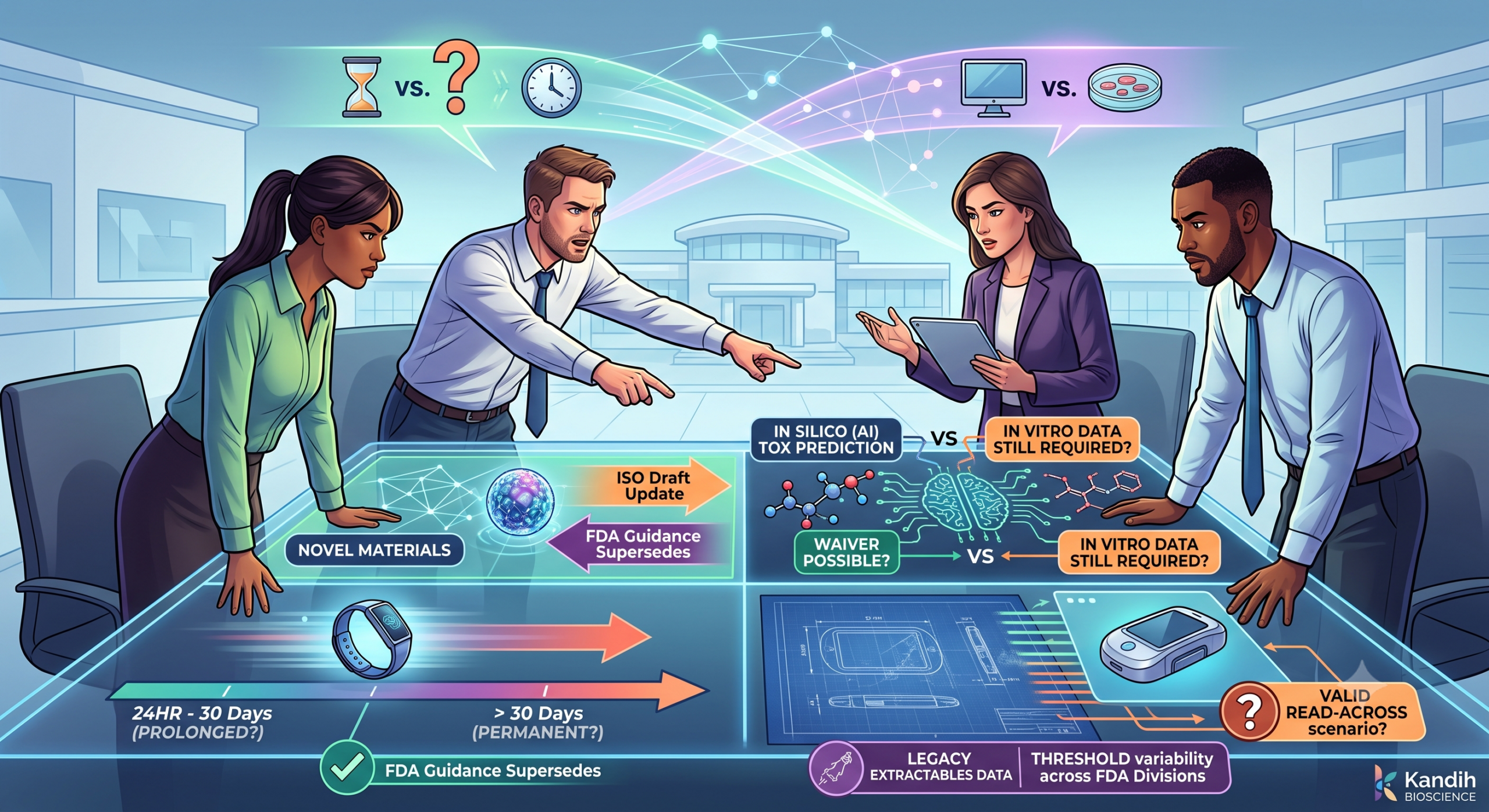
From r/Biocompatibility: “Went to a biocompatibility working group meeting last month. Two senior assessors couldn’t agree on whether a 2-week extractables study covered a device with 29-day wear. Someone cited a draft ISO update. Someone else said FDA’s guidance supersedes it. Nobody landed on an answer. I’m a small-company founder trying to figure out what I’m supposed to do with that.”
That post hit a nerve. Within 24 hours it had 300 comments. Half of them were from regulatory professionals. The other half were from founders, engineers, and quality leads trying to figure out whose interpretation they were supposed to follow.
Here is the honest answer: biocompatibility assessment has always involved professional judgment. But in 2026, the debates inside the assessor community are sharper and more consequential than they’ve been in years. New ISO updates, FDA’s evolving stance on computational toxicology, the growing use of artificial intelligence in extractables prediction, and unresolved questions about wearable and implantable device thresholds are all creating genuine uncertainty at the expert level.
That uncertainty trickles down. Founders building submission packages, investors evaluating regulatory readiness, and quality teams trying to interpret FDA deficiency letters are all trying to navigate a field where the map is actively being redrawn.
This blog is about what’s actually being debated, why it matters at every stage of a device company’s journey, and what a sound biocompatibility strategy looks like when the rules are still being written.
What Is the Biocompatibility Debate, Really?
Most people outside the regulatory world assume biocompatibility is a settled science. You test a device. It passes or fails. Done.
That’s not how it works.
Biocompatibility is a risk assessment, not a binary test. It asks: given everything we know about this device — its materials, its manufacturing history, its sterilization process, its contact type, its duration of use, its patient population — is the biological risk acceptable?
That question requires professional judgment at every step. And right now, in 2026, several foundational elements of that judgment are being actively reconsidered by the people who write the standards.
Here are the four debates that are generating the most friction:
Debate 1: How close to ‘30 days’ is still ‘prolonged contact’?
ISO 10993-1 classifies device contact duration in three buckets: limited (under 24 hours), prolonged (24 hours to 30 days), and permanent (over 30 days). The classification drives which biological endpoints are required.
The grey zone is at the edges. A wearable device with a labeled wear time of 14 days falls into prolonged contact. But what about a device labeled for ‘up to 29 days’? What about a device where clinical evidence shows patients frequently wear it longer than labeled? What about cumulative wear time across multiple back-to-back applications?
Assessors do not agree on how to handle these edge cases. FDA reviewers do not always reach the same conclusion. The 2021 update to ISO 10993-1 clarified some of this language but left room for interpretation that is still being argued in working groups today.
Debate 2: When does AI-based toxicology prediction replace in vitro testing?
Computational toxicology — using software models to predict whether a chemical is toxic before running a lab test — has been part of the ISO 10993-18 chemical characterization framework since its 2020 revision. The standard allows in silico (computer-based) toxicity predictions to be used as part of the safety risk assessment for extractable chemicals.
What’s actively debated in 2026: how much weight should a computational prediction carry when FDA is deciding whether to accept a waiver of in vitro testing? Different assessors draw the line in different places. Some accept well-documented (Q)SAR models as sufficient for low-concern extractables. Others require confirmatory in vitro data regardless. FDA guidance has not resolved this in a way that produces consistent reviewer decisions.
For a founder deciding whether to run an additional cytotoxicity test or rely on a computational argument, this uncertainty has real budget and timeline implications.
Debate 3: Whose threshold applies for nano-enabled and biologic-adjacent materials?
The ISO 10993 framework was developed primarily around conventional polymer, metal, and ceramic medical devices. In 2026, an increasing share of new device submissions involve nanomaterials, bioactive coatings, combination product elements, and materials with drug-like biological activity.
For these materials, the standard biological evaluation endpoints may not be sufficient — and the appropriate thresholds are not always clear. ISO Technical Report 10993-22 addresses nanomaterials, but it’s a technical report rather than a normative standard, which means assessors treat it as guidance rather than requirement. The result: significant variability in how nano-enabled device submissions are evaluated by different FDA divisions.
Debate 4: Does legacy extractables data still apply to a redesigned device?
Many established device manufacturers have biocompatibility data that is years or decades old. The original testing was conducted on an earlier material formulation, an earlier sterilization process, or an earlier device geometry. Since then, the device has been through multiple design iterations.
The question being debated at the assessor level: under what conditions can legacy extractables and toxicology data be read across to a modified device, and under what conditions is fresh chemical characterization required? ISO 10993-18:2020 provides a framework, but the application of that framework to specific scenarios — especially where a supplier changed a material formulation without the device manufacturer’s knowledge — is still generating inconsistent assessor conclusions.
If you’re new to biocompatibility and wondering why this feels more complicated than it should: it’s because it is more complicated than most introductory explanations let on. The standards exist. The framework is real. But inside that framework, experienced professionals are still reaching different conclusions on the same set of facts. Knowing that doesn’t make your job easier — but it does explain why a supplier certificate or a material data sheet isn’t going to be enough.
What These Debates Mean for Your Submission Right Now
If you’re actively building a biocompatibility file for a 510(k), PMA, or De Novo submission in 2026, these debates aren’t just academic. They affect the decisions you’re making right now about which tests to run, which data to rely on, and how to write the biological evaluation report that FDA will review.
Here’s how each debate translates into a practical decision point:
On contact duration edge cases:
If your device sits anywhere near the 30-day threshold — or if your labeling allows cumulative use that could approach it — the conservative position is to evaluate for permanent contact endpoints. It costs more testing budget upfront. But a deficiency letter asking for chronic toxicity or implantation data after you’ve submitted costs far more, in time and money, than running the study proactively.
The more important point: document your reasoning. If you’re classifying your device as prolonged rather than permanent contact, write out the rationale in your biological evaluation plan. Show your math. If an FDA reviewer disagrees with the classification, a documented rationale is the foundation of a defensible response. An undocumented assumption is not.
On computational toxicology:
In silico predictions are a legitimate tool in the ISO 10993-18 framework. But in 2026, the safest use of computational predictions is as a screening tool to identify which extractables warrant further investigation — not as a standalone justification for waiving in vitro testing on chemicals with uncertain toxicity profiles.
If your chemical characterization strategy relies heavily on (Q)SAR models, have a regulatory professional review the argument before it goes to FDA. The model’s output is only as useful as the argument you build around it — and FDA reviewers are increasingly sophisticated about spotting computational arguments that don’t hold up to scrutiny.
On novel and nano-enabled materials:
If your device involves nanomaterials, bioactive surfaces, or any material that doesn’t fit cleanly into the conventional polymer-metal-ceramic framework, the standard ISO 10993 endpoint list is a starting point, not a ceiling. You’ll need to think through what additional characterization is appropriate for your specific material, and you’ll need to document that thinking.
The worst outcome in this space is submitting a standard biological evaluation and having FDA come back asking why you didn’t address material-specific safety questions your assessor should have flagged. This is a common deficiency pattern for nano-enabled devices in 2026, and it’s entirely preventable with upfront expert review.
On legacy data read-across:
If you’re relying on biocompatibility data that was generated on a prior version of your device, you need a formal read-across justification that documents what changed, why the original data still applies, and what — if anything — requires fresh characterization.
A read-across justification is not a paragraph saying ‘the materials are similar.’ Under ISO 10993-18:2020, it’s a documented comparison of the chemical characterization data for both material configurations, with a risk-based argument for why the differences don’t change the safety conclusion.
If you haven’t done that analysis, your legacy data doesn’t cover your current device — regardless of how similar the materials feel.
The founders who navigate these debates successfully in 2026 are the ones who build their biocompatibility strategy around a documented risk argument, not a checklist. The checklist tells you what to include. The argument tells FDA why it’s sufficient. Both have to be there.
As a Founder: Can You See Yourself in This?
You’ve been building this device for two, maybe three years. You know it works. You have data. You have a plan.
But somewhere in the past few months, the biocompatibility section of your submission became the thing that keeps you up at night. Not because you think your device is unsafe — you don’t. But because you’re not sure your documentation will survive FDA review. And you’re not sure who to ask that you can actually trust to give you a straight answer.
Maybe your materials supplier gave you a data sheet that looks thorough but your regulatory consultant is asking questions about it you can’t answer. Maybe you ran biocompatibility testing but it was on an early prototype and you’ve made three material decisions since then. Maybe you’re 60 days from your planned submission date and someone just mentioned the words ‘chemical characterization’ for the first time.
Any of those scenarios is fixable. None of them is unusual. But all of them get more expensive the closer you get to submission without resolving them.
The question isn’t whether you can afford to have someone review your biocompatibility file. It’s whether you can afford the cost of a major deficiency letter after you submit without one.
A major biocompatibility deficiency in 2026 typically costs $40,000 to $80,000 in direct response costs — new testing, consultant time, revised report, FDA response. Plus 3 to 6 months of additional timeline. Plus the runway that burns while you wait. The review that could have caught it costs a fraction of that and takes days, not months.
As an Investor: What Are You Actually Looking At?
If you’re evaluating a medical device company in 2026 and their biocompatibility story is ‘we’re using ISO 10993-compliant materials’ — that’s a starting point, not a conclusion.
Here’s what to ask:
- Has a biological evaluation plan been written? Not just testing — a documented plan that maps the device’s contact type, duration, and materials to specific ISO 10993 endpoints, with a rationale for endpoints that were waived?
- If the device has any contact duration near 30 days, has the team documented their classification rationale? Have they evaluated for permanent-contact endpoints or justified why prolonged-contact endpoints are sufficient?
- Has chemical characterization been conducted under ISO 10993-18:2020? If the team is relying on in silico predictions, is there a qualified assessor who reviewed the argument?
- If any materials, suppliers, or manufacturing processes changed since the last biocompatibility testing, has a read-across justification been prepared?
- Has the biological evaluation report been reviewed by someone who has prepared FDA submissions before — not just run the tests?
A team that can answer those questions specifically, with documents, has built a biocompatibility strategy that can survive FDA review. A team that can’t is carrying regulatory risk that hasn’t been priced into the timeline or the budget.
In 2026, with assessors actively debating the interpretation of the standards your portfolio company is relying on, this is not the section of diligence to skip.
Where Kandih Bioscience Comes In
The biocompatibility debates happening in assessor working groups in 2026 are real. The uncertainty they create for founders and investors is also real. But uncertainty doesn’t have to mean paralysis.
At Kandih Bioscience, we sit inside this debate every day. We know where FDA reviewers are drawing lines on contact duration classification. We know how to build a defensible in silico argument and when to push for confirmatory testing instead. We know what legacy data read-across looks like when it holds up to scrutiny and when it doesn’t.
We work with device companies at every stage of biocompatibility strategy:
- Early development: building a biological evaluation plan that anticipates the questions FDA will ask, before testing begins — so the right studies are run on the right samples the first time
- Pre-submission review: reviewing your existing biological evaluation report, testing data, and chemical characterization for the arguments FDA reviewers are most likely to challenge in 2026
- Deficiency response: preparing responses to FDA’s biocompatibility questions that are specific, documented, and built on the current state of the ISO 10993 framework — not last year’s interpretation
- Investor diligence: translating a device company’s biocompatibility documentation into a plain-language risk assessment you can actually use to make a decision
If you’re a founder who wants to know whether your biocompatibility file will hold up — before FDA tells you it won’t — book a review.
If you’re an investor who wants to understand what a company’s biocompatibility strategy actually means for their clearance timeline and budget, reach out.
The debates in the assessor community aren’t going to resolve themselves before your submission date. But the right strategy, documented correctly, can navigate them.
→ Book a Biocompatibility Review: kandih.com/bio_compatibility
Contact Kandih Bioscience • [email protected] • kandih.com • 240.565.8933
References
2. ISO 10993-1:2018 — Biological Evaluation of Medical Devices: Evaluation and Testing Within a Risk Management Process (2018, confirmed 2023)
4. ISO/TR 10993-22:2017 — Guidance on Nanomaterials (2017)
5. FDA — Biocompatibility of Medical Devices: Overview and FDA’s Approach (2021, updated 2024)
6. OECD — Guidance Document on the Validation of (Quantitative) Structure-Activity Relationship [(Q)SAR] Models (2014, reference standard for in silico toxicology)
#Biocompatibility #ISO10993 #MedTech #MedicalDevices #FDARegulatory #2026MedTech #RegulatoryStrategy #KandihBioscience