
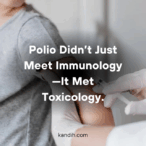
Polio was once one of the world’s most feared diseases—paralyzing or killing hundreds of thousands every year. Thanks to vaccines, it’s now on the brink of eradication. But here’s what most people overlook: toxicology is the silent science that makes vaccines safe enough to save millions.
If you’re a public health leader, clinician, or pharmaceutical scientist, the clear idea is this:
Every vaccine’s success depends on toxicology’s ability to predict, prevent, and monitor harm—without compromising protection.
Why Toxicology Belongs in the Polio Vaccine Conversation
The story of the polio vaccine—both inactivated (IPV) and oral (OPV)—is also the story of how modern vaccine toxicology was built.
Here’s how toxicology continues to shape vaccine safety:
1. Ingredient Evaluation
Every component—viral antigen, stabilizer, adjuvant, and preservative—is tested for safety long before clinical trials. Toxicologists assess potential neurotoxicity, reproductive toxicity, allergenicity, and cumulative exposure across doses and age groups.
2. Dose and Formulation
Toxicology determines the minimal effective antigen dose that triggers immunity while minimizing systemic or local toxicity. That’s how vaccines achieve efficacy without overwhelming the immune system.
3. Manufacturing Oversight
The 1955 Cutter Incident, in which a batch of the Salk vaccine contained live poliovirus, remains a defining moment. It led to sweeping reforms in vaccine toxicology and FDA biologics oversight, including mandatory preclinical safety testing, inactivation validation, and lot-by-lot release controls.
4. Risk–Benefit Modeling
Rare cases of vaccine-derived poliovirus (VDPV) occur in under-immunized populations receiving oral vaccines. Toxicology helps define dose control, inactivation thresholds, and surveillance systems that reduce these risks while preserving protection.
Practical, Tactical Takeaways for Professionals
Understand the Safety Backbone
When discussing vaccines with the public or policymakers, emphasize that toxicologists test every vaccine ingredient under Good Laboratory Practice (GLP) standards to confirm its safety before human use.
Communicate Transparent Safety Data
Trust grows when clinicians and leaders explain how toxicology drives continuous safety evaluation—from animal studies to post-market surveillance.
Monitor Adverse Events Proactively
Adverse event data only make sense in context. Toxicologists interpret reports based on timing, dose, and co-exposures (e.g., medications, environmental chemicals) to separate real safety signals from coincidence.
Support Research in Immunotoxicology
Encourage work that models immune response dynamics and chemical adjuvant safety, reducing unnecessary exposures and refining vaccine formulations for long-term safety.
From Experience: Why This Matters
From Experience: Why This Matters
In one regulatory submission, a manufacturer reformulated an inactivated viral vaccine to improve shelf stability. The FDA required detailed toxicology studies to confirm that even trace levels of the new stabilizer—used in microgram quantities—remained well below toxic thresholds established through preclinical data. The findings demonstrated that the reformulation posed no additional neurotoxicity or systemic risk, satisfying regulatory standards for biologic safety evaluation (Lewis et al., 2013).
The takeaway is clear: toxicology isn’t just a formality—it’s the foundation of public trust. Every modern vaccine approval, from polio to COVID-19, rests on the same principle: safety is not assumed—it’s proven through data.
The Bottom Line
Polio’s near-eradication is a victory not only for immunology but also for toxicology.
The clear idea: Every safe vaccine stands on the science of exposure, dose, and safety margins defined by toxicologists.
As the world renews its push to eradicate polio, understanding toxicology’s role ensures we don’t just chase immunity—we preserve safety along the way.
References
1. Centers for Disease Control and Prevention (CDC). Polio Vaccination: What Everyone Should Know. https://www.cdc.gov/polio/vaccines/index.html
2. U.S. Food and Drug Administration (FDA). Polio Vaccine Safety and Regulation. https://publichealth.jhu.edu/2025/polio-vaccinations-provide-safe-effective-protection
3. Offit PA. The Cutter Incident: How America’s First Polio Vaccine Led to the Growing Vaccine Crisis. Yale University Press, 2005. https://pmc.ncbi.nlm.nih.gov/articles/PMC1383764
4. Jacques Descotes, et al. Methods of evaluating immunotoxicity, 2006 Apr;2(2):249-59. https://pubmed.ncbi.nlm.nih.gov/16866611