Cannabis & Polypharmacy: The Brutal New Side Effect No One Warned You About

Scromiting”: The Brutal Side Effect of Chronic Cannabis Use That’s Changing How We Think About Toxicology
December 2, 2025
Terpenes & Drug Interactions: The Brutal New Side Effect of Chronic Cannabis Use
December 4, 2025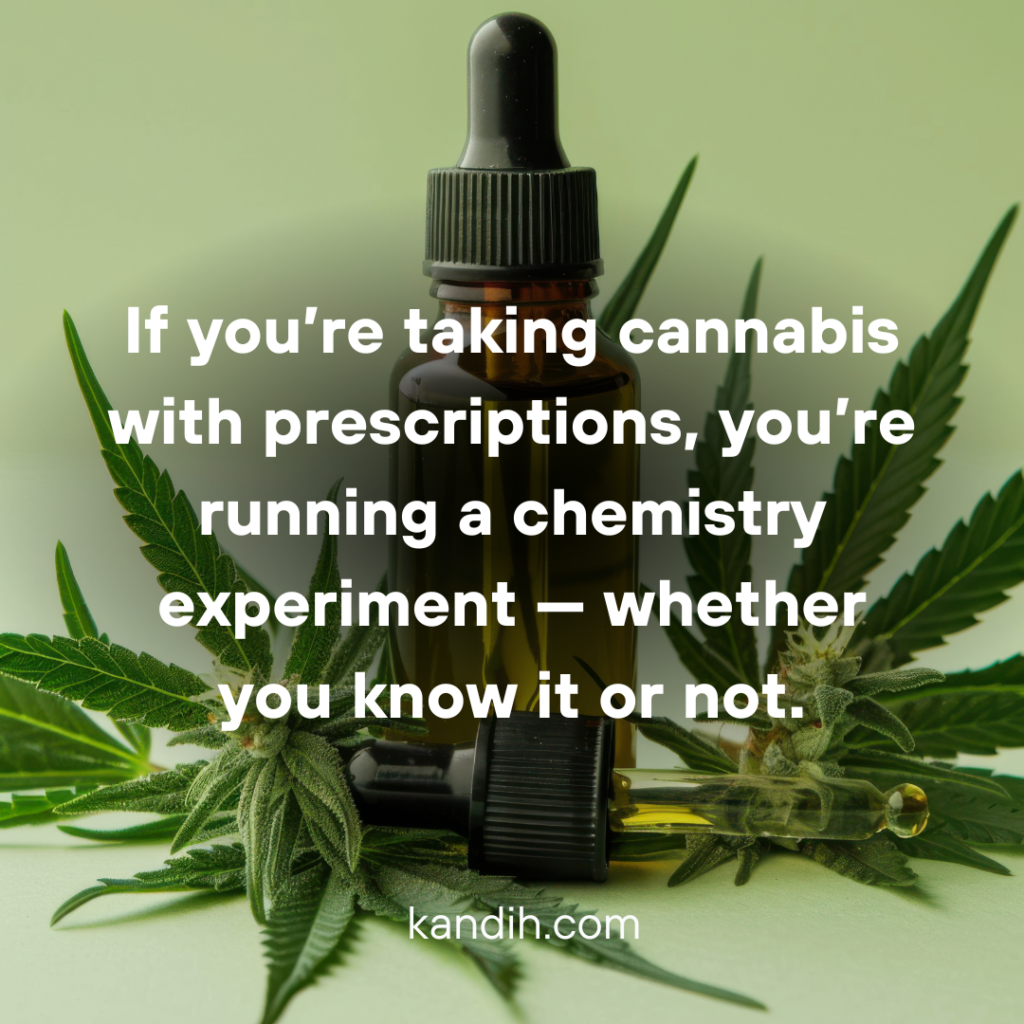
(A Regulatory Toxicologist’s Take on the Hidden Risk Behind “Natural Relief”)
By Dr. Harriet Kamendi, PhD — Regulatory Toxicologist & CEO, Kandih BioScience
Project CBD recently reported a growing trend in the U.S.:
adults reducing or replacing prescription medications with cannabis, while others add cannabis on top of already complex drug regimens.
(Project CBD)
This is where the story turns from wellness to risk.
Chronic cannabis use + multiple medications = a pharmacology interaction zone with no referee — and toxicology is the missing discipline.
If you work in healthcare innovation, drug development, wellness products, or cannabinoid science, here’s the one clear idea:
Cannabis isn’t dangerous because it’s “bad.” It’s dangerous because it interacts with medications in ways most people — and many clinicians — don’t understand.
Let me say the quiet part out loud as a toxicologist:
“Natural” does not mean pharmacologically neutral.
Why Cannabis + Polypharmacy Is a Toxicology Problem
Cannabis doesn’t simply “add” to drug regimens — it rewires the exposure landscape.
1. CYP450 Enzyme Interference: The Chemical Traffic Jam
THC, CBD, CBG, and their metabolites all interact with liver enzymes responsible for breaking down most prescription drugs, especially:
CYP3A4 → metabolizes ~30% of all pharmaceuticals
CYP2C9
CYP2C19
UGT enzymes
When cannabis inhibits these enzymes, drugs build up to higher levels than intended, increasing toxicity risk.
This can amplify or destabilize medications used for:
hypertension
depression or anxiety
diabetes
anticoagulation (blood thinners)
insomnia
pain
seizures
From a toxicologist’s perspective, this isn’t a side note — it is the central safety issue.
2. Cannabis Is Biphasic — A Regulatory Nightmare
Cannabis has opposite effects at different doses:
Low dose → calming, anti-nausea
High dose → anxiety, paranoia, rebound nausea
When combined with medications acting on:
serotonin
dopamine
GABA
the endocannabinoid system
…the results are often unpredictable.
This is mixture toxicology, not single-agent exposure.
Regulators currently do not classify cannabis + meds as a combination product — but biologically, that’s exactly what it is.
3. Chronic Cannabis Use Changes Physiology
Long-term cannabis use can:
influence blood pressure swings
alter appetite hormones
shift opioid receptor sensitivity
increase or destabilize anxiety
disrupt REM sleep
affect glucose control
When layered on top of existing medications, the toxicology landscape isn’t linear — it’s multidimensional.
From a regulatory toxicology standpoint, this is precisely why cannabis should be treated as a pharmacologic exposure, not a casual supplement.
What Product Developers Must Learn — Immediately
Whether you’re formulating edibles, wellness tinctures, CBD oils, or THC beverages, you are already operating in a drug–interaction ecosystem.
1. Build Drug–Cannabinoid Interaction Data Into R&D
Responsible development means:
Modeling CYP450 interactions
Using in silico drug–interaction prediction tools
Testing formulations against commonly co-used medications
If you skip this, you’re flying blind.
2. Prioritize Exposure Science, Not Just Potency
Most companies still design products based on:
taste
experience
potency
branding
But toxicologists care about:
chronic THC/CBD accumulation
metabolite toxicity
slow hepatic clearance
food-effect interactions
tolerance and receptor desensitization
These determine long-term safety, not the label.
3. Labeling Must Catch Up
Hemp/CBD/THC products should include warnings for interactions with:
CNS depressants
SSRIs & SNRIs
benzodiazepines
beta blockers
insulin & hypoglycemics
anticoagulants
antiepileptics
This is not alarmist — it is standard risk communication.
4. Use Real-World Evidence (RWE) as a Surveillance System
Cannabis is not taken in controlled laboratories.
Users stack:
edibles
vapes
alcohol
medications
supplements
RWE + toxicology = early detection of:
cognitive impairment
tachycardia
mood destabilization
hepatotoxicity
bleeding events
hypoglycemia
This should feed directly into product reformulation and labeling.
My Professional Opinion
As a regulatory toxicologist, here’s my frank view:
The cannabis industry has scaled faster than the safety science needed to support it.
Polypharmacy isn’t niche — it is the defining challenge of modern cannabis use.
Older adults are:
the largest group taking multiple medications
one of the fastest-growing groups adopting cannabis
And yet many product developers approach cannabis like aromatherapy.
My stance is simple:
Cannabis is a pharmacologically active compound.
Treat it with pharmaceutical respect.
Until drug–interaction toxicology is built into every stage of development, the ER visits will continue — and so will preventable harm.
The Bottom Line
The most dangerous side effect of chronic cannabis use in 2025 is not paranoia or cognitive fog.
It’s polypharmacy without toxicological oversight.
If your product interacts with the endocannabinoid system, you’re now in the drug–interaction business.
Toxicology is not a barrier to innovation.
It is the infrastructure that lets innovation survive real-world use.
Separately let us all not forget the terpenes…. A story for another day…. Another blog
Reference Links
1. Project CBD — Cannabis Instead of Polypharmacy
https://projectcbd.org/safety/cannabis-instead-of-polypharmacy
2. U.S. FDA — Cannabis and Cannabis-Derived Products: Quality Considerations
https://www.fda.gov/news-events/public-health-focus/fda-regulation-cannabis-and-cannabis-derived-products-including-cannabidiol-cbd
3. CDC — Cannabis and Health Effects
https://www.cdc.gov/cannabis/health-effects/index.html
4. Stout SM & Cimino NM. Exogenous Cannabinoids and Drug Interactions. J Clin Pharmacol. 2014
https://www.tandfonline.com/doi/full/10.3109/03602532.2013.849268
5. Huestis MA. Human Cannabinoid Pharmacokinetics. Chem Biodivers. 2007
https://pmc.ncbi.nlm.nih.gov/articles/PMC2689518