
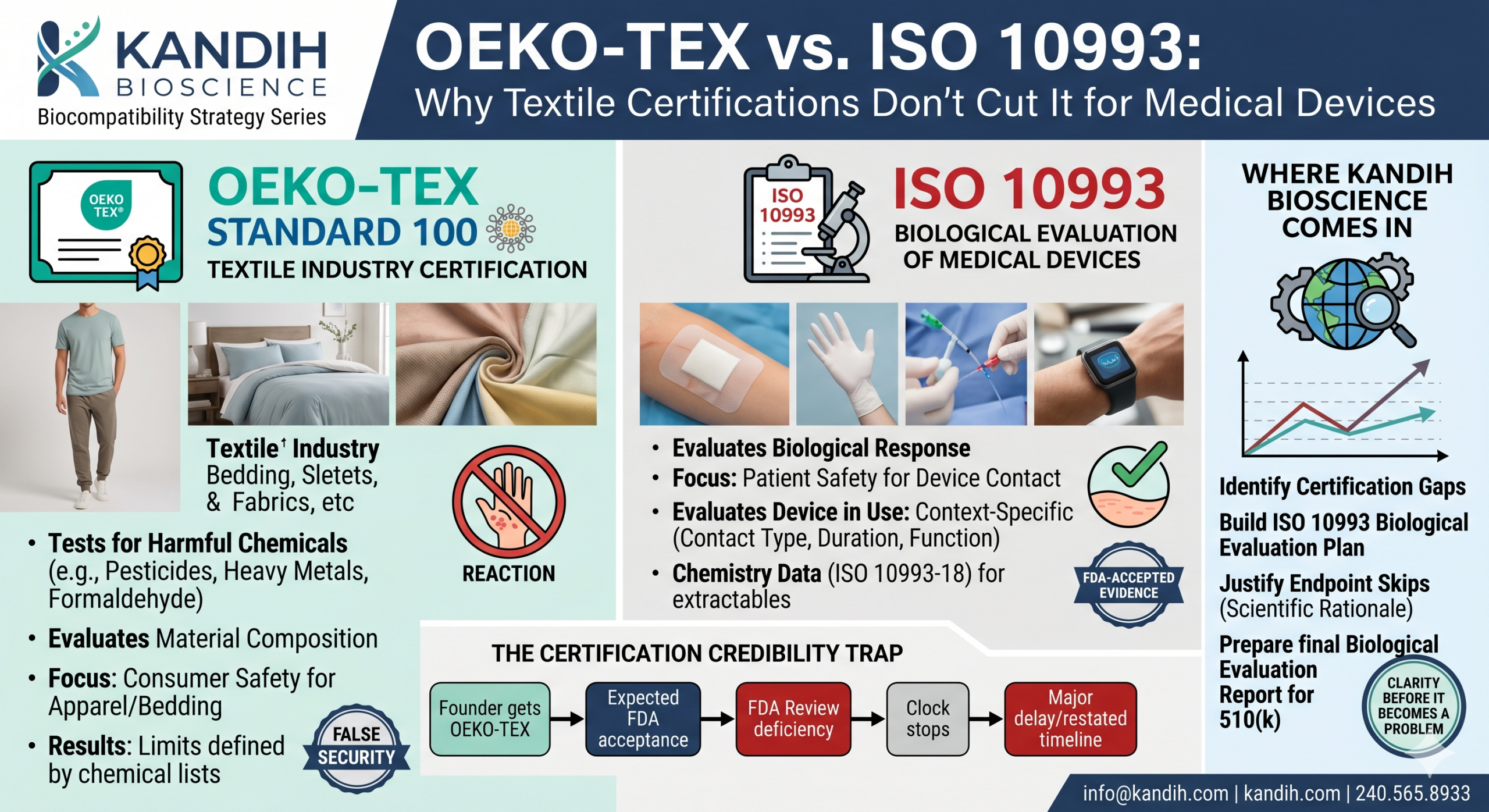
OEKO-TEX vs. ISO 10993: Why Textile Certifications Don’t Cut It for Medical Devices
By Kandih Bioscience • Biocompatibility Strategy Series
From r/medicaldevices: “We have OEKO-TEX STANDARD 100 certification on all our textile components. Our investor keeps asking if that’s ‘good enough’ for FDA. Honestly — I don’t know what to tell them.”
If you’re a founder or an investor in the medical device space, this scenario probably feels familiar. You’ve spent real money getting your textile materials certified. The certificate looks official. It has logos, test numbers, a clean layout. It says the materials are safe.
So why does FDA keep acting like it doesn’t exist?
Here’s the short answer: OEKO-TEX and FDA’s biocompatibility requirements are solving two completely different problems. One was built for clothing. The other was built for devices that go on — or inside — the human body. Mixing them up is one of the most expensive mistakes a device company can make. And it happens more often than you’d think.
What OEKO-TEX Actually Certifies
OEKO-TEX STANDARD 100 is a textile industry certification. It was created to give consumers confidence that the clothes, bedding, and fabrics they buy don’t contain harmful levels of certain chemicals — things like pesticide residues, heavy metals, and formaldehyde.
It’s a good certification for what it is. It tells you that a fabric was tested against a defined list of chemical limits, and that it passed. For a clothing brand, that’s a meaningful statement.
But here’s what OEKO-TEX does not tell you:
- Whether the material causes a reaction when it stays in contact with skin for extended periods
- Whether it triggers sensitization after repeated exposure
- Whether it releases harmful substances when it interacts with wound fluid, blood, or tissue
- Whether it’s safe when implanted, or used near a mucous membrane, or placed over broken skin
OEKO-TEX tests for the presence of specific chemicals at specific thresholds. It does not evaluate biological response. Those are fundamentally different things.
As a founder, this distinction matters because it affects your risk profile directly. A certification your regulatory team can’t actually use is not an asset — it’s a false sense of security that can delay your clearance by months.
What ISO 10993 Actually Requires
ISO 10993 is the international standard that governs biological evaluation of medical devices. It’s the framework FDA uses to decide whether a device is safe for patient contact. And it asks very different questions.
The standard doesn’t just ask: “Does this material contain bad chemicals?”
It asks: “How does the human body respond to this material — under the specific conditions this device will create?”
That means the evaluation depends on three things:
- How the device contacts the body — skin surface, intact skin, broken skin, a wound, a mucous membrane, blood, tissue, bone
- How long that contact lasts — a few minutes, a few hours, more than 30 days
- What the device actually does in use — does it stay dry, does it absorb fluid, does it move against tissue, does it get sterilized repeatedly
Depending on your answers, you may need to evaluate your device for cytotoxicity, sensitization, irritation, systemic toxicity, genotoxicity, implantation effects, and more. Each of those is a biological endpoint — none of them show up in an OEKO-TEX certificate.
For investors evaluating a textile-based device company: if the regulatory dossier only references OEKO-TEX and doesn’t include a biological evaluation plan aligned to ISO 10993, that’s a red flag. It suggests the team hasn’t fully mapped their regulatory pathway.
The Certification Credibility Trap
One of the most common patterns we see is this: a founder builds a textile-based device, invests in OEKO-TEX certification because it’s what the textile industry uses, then enters the regulatory process expecting FDA to accept it as biocompatibility evidence.
FDA doesn’t reject OEKO-TEX because it’s a bad test. FDA rejects it because it wasn’t designed to answer the questions FDA is asking.
The standard FDA uses is its own guidance document on ISO 10993-1. That document is very specific about what counts as adequate biocompatibility evidence. It requires:
- A biological evaluation plan that justifies which endpoints were evaluated
- Testing or scientific justification for each applicable endpoint
- Chemistry data (under ISO 10993-18) if the device has a fluid contact pathway or if extractables are a concern
- A final biological evaluation report that ties everything together
None of this is produced by an OEKO-TEX audit. That doesn’t mean OEKO-TEX data is worthless — in some cases, it can be referenced as supporting information. But it cannot substitute for a proper ISO 10993 evaluation. Not for any device class.
What This Means if You’re a Founder
You’ve probably already noticed that the timeline between “we’re ready to submit” and “we actually submitted” is longer than you expected. Biocompatibility is one of the biggest reasons for that gap.
Here’s the honest picture:
- If you’re planning a 510(k) for a Class II textile device — a wound dressing, a compression garment, a wearable sensor platform, a catheter cover — you need ISO 10993-compliant biocompatibility testing or documented scientific justification for each biological endpoint
- That process takes time. A full cytotoxicity and sensitization study through an accredited lab typically takes 4 to 8 weeks, not counting the time to prepare samples and write up the evaluation
- If you discover the gap during FDA review rather than before submission, you’re looking at a major deficiency, a clock stop, and the possibility of restarting your review timeline entirely
The earlier you address biocompatibility in your development timeline, the cheaper it is to fix. Testing before you scale manufacturing is far less painful than testing after you’ve locked your materials and your suppliers.
Founders who treat biocompatibility as an afterthought consistently underestimate how long it takes to generate compliant data. Building it into your development roadmap from the start — not just your submission prep — is one of the highest-leverage decisions you can make for your timeline.
What This Means if You’re an Investor
When you’re evaluating a textile-based medical device company, the biocompatibility documentation is a proxy for regulatory maturity. Here’s a simple framework for reading it:
- Green flag: The company has a biological evaluation plan, a list of applicable endpoints based on device contact type and duration, and either completed testing or written justification for each endpoint that references ISO 10993
- Yellow flag: They have OEKO-TEX or other textile certifications, but no biological evaluation plan. They may be unaware of the gap, or they may believe the certifications are sufficient — either way, regulatory work remains
- Red flag: The team cannot explain what ISO 10993 requires for their device, or conflates material safety certifications with FDA biocompatibility compliance
A company that’s done this work correctly will be able to walk you through their biological evaluation plan in plain language. They’ll know which endpoints apply, why, and what data they have. If that conversation is vague or defensive, the gap is real — and it will cost money to close.
Where Kandih Bioscience Comes In
The OEKO-TEX vs. ISO 10993 confusion isn’t a sign that a company is doing something wrong. It’s a sign that they’ve been operating in a textile industry framework and are now moving into a medical device regulatory framework. Those two worlds have different rules, different standards, and very different expectations from regulators.
The transition from one to the other is exactly the kind of problem Kandih Bioscience was built to solve.
We work with medical device companies — including those with textile-based and wearable devices — to build biological evaluation strategies that actually hold up under FDA review. That means:
- Reviewing your existing material certifications and identifying what they can and cannot support
- Building a biological evaluation plan that maps your device’s contact type, duration, and risk profile to the correct ISO 10993 endpoints
- Identifying which tests you genuinely need versus which ones you can justify skipping with solid scientific rationale
- Preparing the biological evaluation report in a format that integrates cleanly with your 510(k) submission
If you’re a founder trying to figure out what your textile certification does and doesn’t cover, we can give you a straight answer. If you’re an investor doing technical due diligence on a device company’s regulatory readiness, we can help you understand what you’re looking at.
Either way, the goal is the same: clarity, before it becomes a problem.
Talk to Kandih Bioscience — [email protected] | kandih.com | 240.565.8933
References
1. FDA — Use of International Standard ISO 10993-1: Biological Evaluation of Medical Devices (2020)
2. OEKO-TEX — OEKO-TEX STANDARD 100: What It Tests and What It Means (2024)
3. ISO — ISO 10993-1: Biological Evaluation of Medical Devices — Evaluation and Testing Within a Risk Management Process (2018)
4. ISO — ISO 10993-18: Chemical Characterization of Medical Device Materials Within a Risk Management Process (2020)
5. FDA — Biocompatibility of Medical Devices: Overview and FDA’s Approach (2021)
6. FDA — Guidance on the Use of ISO 10993-10: Tests for Skin Sensitization (2023)