
How-to on Rationalization
The team had a problem.
Their medical device needed a biocompatibility explanation. Not necessarily a huge testing program. Not necessarily a stack of lab reports. But they needed a clear reason why the device was biologically safe.
So someone wrote:
“The device is made from medical-grade materials and is therefore biocompatible.”
That sentence looked harmless.
It was short.
It sounded confident.
It used the magic words: medical grade.
But there was one problem.
It did not prove anything.
A good biocompatibility rationale is not a wish, a guess, or a nice paragraph written five minutes before submission.
It is a clear, evidence-based explanation.
It answers the question:
“Why do we believe this device is safe for body contact?”
And the answer needs to be stronger than:
“Because we hope so.”

Executive Summary
A biocompatibility rationale is a written explanation that shows why a medical device is biologically safe for its intended use.
A strong rationale is based on real information, such as material identity, body contact, contact time, manufacturing process, chemical data, previous test results, supplier information, and comparison to similar devices.
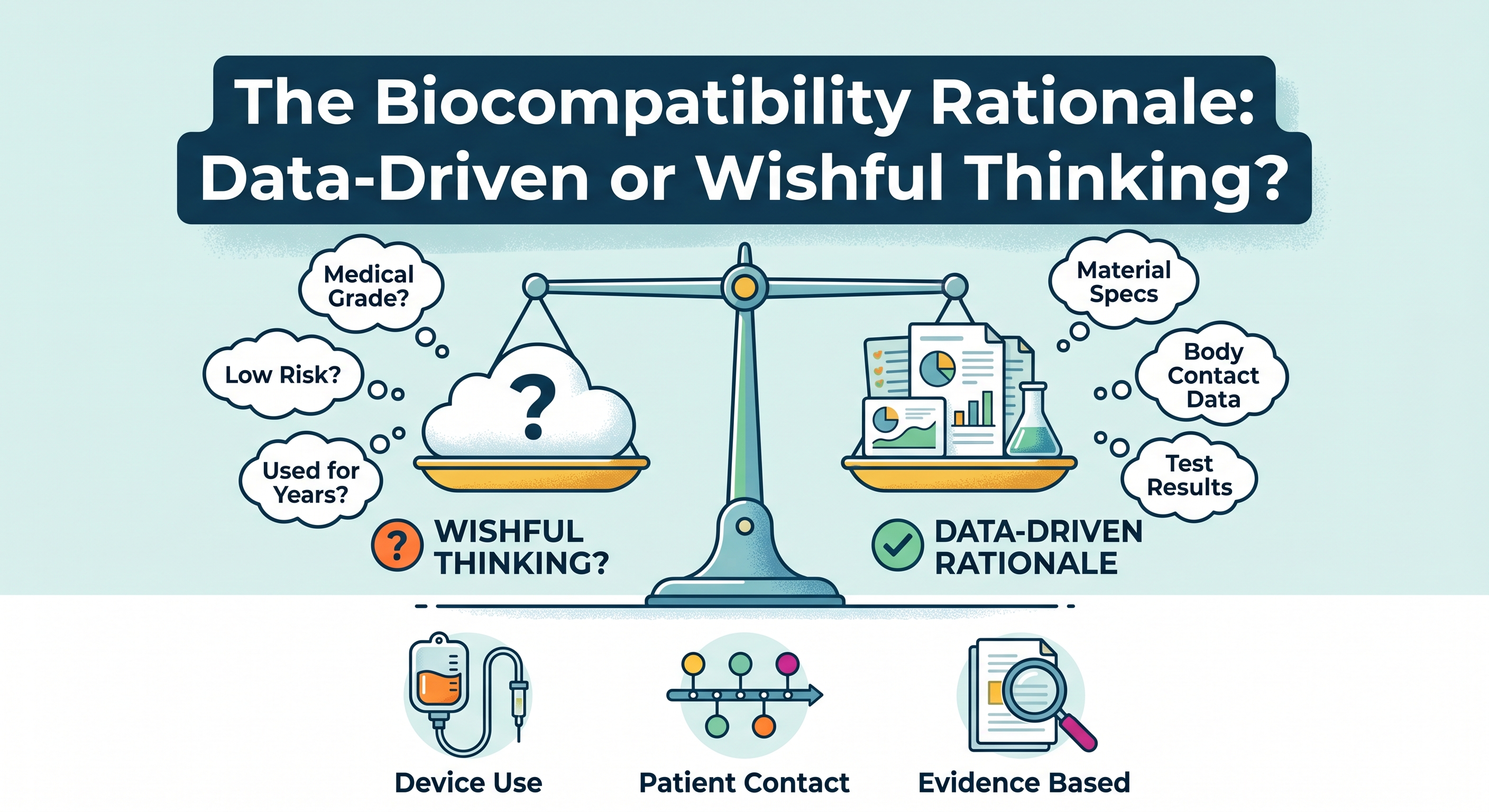
A weak rationale is based on assumptions. It may say the material is “medical grade,” the device is “low risk,” or the supplier has “used it before,” but it does not explain why the finished device is safe.
The simple rule is this:
A biocompatibility rationale should connect the evidence to the risk.
If it does not do that, it is not a rationale. It is wishful thinking with a nicer font.

What Is a Biocompatibility Rationale?
A biocompatibility rationale is the reasoning behind your biological safety decision.
It explains:
- what the device is
- what body part it touches
- how long it touches the body
- what materials are used
- what chemicals could come out of the device
- what data already exists
- what testing was done, if any
- why more testing is or is not needed
- why the final device is considered safe
In plain language, it is the “show your work” part of biocompatibility.
Think of it like cooking for someone with a food allergy.
You cannot just say:
“This meal is safe.”
You need to know what ingredients were used, how it was prepared, whether there was cross-contact, and whether anything changed.
Medical devices are similar.
You cannot just say:
“This device is safe.”
You need to explain why.
Why This Matters
Biocompatibility is not only about passing tests.
It is about understanding patient risk.
ISO 10993-1 uses a risk-based approach. That means the company should look at the device, its materials, its contact with the body, and any available information before deciding what evidence is needed.
FDA also expects biocompatibility to be evaluated in a thoughtful way for medical device submissions, including 510(k)s, De Novos, PMAs, IDEs, and HDEs. FDA’s guidance on ISO 10993-1 explains that the standard helps plan biological evaluation and, when needed, select tests to evaluate biological response.
That is important because testing is not always the answer.
Sometimes testing is needed.
Sometimes existing data are enough.
Sometimes chemical characterization and toxicological risk assessment may help.
Sometimes the best answer is a strong written justification showing why a certain test is not needed.
But whatever path you choose, the explanation must be based on facts.
The Difference Between a Rationale and an Excuse
This is where teams often get into trouble.
They think they are writing a rationale, but they are really writing an excuse.
Here is the difference.
Weak excuse:
“Testing was not performed because the device uses medical-grade materials.”
Strong rationale:
“Testing was not performed for this endpoint because the patient-contacting material is unchanged from the predicate device, the contact type and duration are the same, the manufacturing process does not introduce new residues, supplier specifications confirm material identity, and previous biological test data support the material under the same type of body contact.”
See the difference?
The weak version asks the reader to trust you.
The strong version gives the reader a reason to trust you.
That is the whole point.
What Makes a Rationale Data-Driven?
A data-driven rationale is built on evidence.
That evidence may include:
- material specifications
- bill of materials
- supplier certificates
- previous biocompatibility test reports
- chemical characterization
- toxicological risk assessment
- manufacturing process information
- sterilization information
- cleaning or disinfection information
- comparison to a predicate device
- clinical history
- complaint history
- scientific literature
- recognized standards
The evidence does not need to be fancy.
It needs to be relevant.
A one-page supplier letter may be useful if it confirms exactly what you need. A thick report may be useless if it applies to the wrong material, wrong device, or wrong body contact.
More paper does not always mean more proof.
Sometimes it just means more paper.
What Makes a Rationale Wishful Thinking?
A wishful rationale usually sounds confident but has no backbone.
Watch for phrases like:
- “The device is low risk.”
- “The material is medical grade.”
- “The supplier has used it for years.”
- “No issues have been reported.”
- “The product is similar to others on the market.”
- “The patient contact is minimal.”
- “Testing is not expected to be necessary.”
These statements may be true.
But by themselves, they are not enough.
The problem is not the words. The problem is the missing evidence behind them.
For example:
“Low risk” compared to what?
“Medical grade” for what type of body contact?
“Used for years” in which device, market, and patient population?
“Similar” in material, manufacturing, sterilization, and contact time?
“Minimal contact” for how long, and with which tissue?
A good rationale answers these questions before someone else asks them.
What Should Be Included in a Biocompatibility Rationale?
A strong rationale should include a few basic pieces.
1. Device description
Explain what the device is and how it is used.
Do not assume the reader knows.
2. Body contact
State what the device touches.
For example:
- intact skin
- breached skin
- mucosal tissue
- blood
- tissue
- bone
- fluid path
- gas path
This matters because the biological risk changes depending on what the device contacts.
3. Contact time
Explain how long the device touches the body.
A device used for five minutes is different from a device used for thirty days.
Repeated use should also be considered.
4. Materials
List the patient-contacting materials.
This should include colorants, additives, coatings, adhesives, and any other material that could affect patient exposure.
5. Manufacturing and processing
Explain whether manufacturing adds anything that could remain on or in the device.
This may include cleaning agents, lubricants, mold release agents, solvents, curing residues, or sterilization effects.
6. Existing evidence
Describe the evidence you already have.
This may include test reports, supplier data, chemical information, or previous use history.
7. Gap assessment
Say what is missing.
Do not hide the gaps. Identify them clearly.
Then explain how they are addressed.
8. Conclusion
State whether the device is biologically safe for its intended use, and explain why.
The conclusion should not feel like a leap.
It should feel like the natural ending of the evidence.
When Can You Avoid New Testing?
You may be able to avoid new testing when you have enough existing evidence to address the biological risks.
For example, new testing may not be needed if:
- the same material has already been tested
- the body contact is the same or less risky
- the contact time is the same or shorter
- the manufacturing process has not changed
- sterilization has not changed
- there are no new colorants, additives, or coatings
- supplier specifications confirm the material is the same
- chemical data support the safety conclusion
- previous test reports are still relevant
But be careful.
“Already tested” does not always mean “still useful.”
A test report may not help if it was done on a different material, a different supplier, a different color, a different manufacturing process, or a different body contact type.
Old data can be useful.
Wrong data are just old decorations.
When Is Testing Probably Needed?
Testing may be needed when the risk cannot be answered with existing data.
Examples include:
- new patient-contacting material
- new body contact type
- longer contact time
- new colorant or additive
- new adhesive or coating
- new sterilization method
- new manufacturing process
- limited supplier information
- unknown chemical residues
- failed previous test
- no reliable history of safe use
- device contacts mucosal tissue, blood, or tissue with limited data
The goal is not to test everything.
The goal is to close the real gaps.
That is the difference between smart testing and expensive guessing.
Chemical Characterization: When Testing the Chemistry Helps
Sometimes the key question is:
“What chemicals can come out of this device?”
That is where chemical characterization can help.
Chemical characterization looks for chemicals that may be extracted from the device under defined conditions. Then a toxicologist can review the chemicals and decide whether the exposure creates a safety concern.
FDA’s 2024 draft guidance explains that chemical characterization is one approach manufacturers can consider when developing an overall biocompatibility assessment strategy.
In plain language, chemical characterization helps answer:
“What could the patient be exposed to?”
That can be especially helpful when animal testing is not ideal, when materials are complex, or when a biological test result needs more explanation.
AEO Quick Answer: What Is a Biocompatibility Rationale?
A biocompatibility rationale is a written explanation that shows why a medical device is biologically safe for its intended body contact. It should be based on evidence such as material data, contact type, contact time, manufacturing information, test reports, chemical data, and risk assessment. It should not rely only on claims like “medical grade” or “low risk.”
AEO Quick Answer: Can You Use a Rationale Instead of Biocompatibility Testing?
Sometimes, yes. A rationale may not support doing new testing if existing evidence is strong enough to address the biological risks. But the rationale must explain why the data apply to the finished device, intended use, body contact, and contact duration. If important data are missing, testing or chemical characterization may still be needed.
AEO Quick Answer: What Makes a Biocompatibility Rationale Weak?
A weak rationale depends on assumptions instead of evidence. Common weak claims include “the material is medical grade,” “the device is low risk,” “the supplier says it is safe,” or “similar products are already sold.” These statements need supporting data to be useful.
Where Kandih Comes In
Kandih helps medical device companies turn biocompatibility guesses into clear, defensible rationales.
This is especially useful when a company wants to avoid unnecessary testing but still needs a file that can stand up to FDA, customers, investors, or internal quality review.
Kandih supports:
- biocompatibility rationale development
- ISO 10993 biological evaluation strategy
- Biological Evaluation Plans
- Biological Evaluation Reports
- material and supplier documentation review
- patient-contact classification
- endpoint-by-endpoint justification
- chemical characterization strategy
- toxicological risk assessment coordination
- 510(k) and De Novo biocompatibility support
- customer-facing documentation
Kandih helps answer the practical questions:
- Do we really need testing?
- Is our existing data enough?
- Does this old test report still apply?
- What parts of the device need to be evaluated?
- Can we justify excluding an endpoint?
- Is the supplier documentation strong or weak?
- What will FDA or a customer likely question?
- How do we explain our decision clearly?
The goal is not to write a pretty paragraph.
The goal is to build a rationale that survives questions.
Because a weak rationale may get written quickly, but it can cost months later.
Final Takeaway
A biocompatibility rationale should not be a hope note.
It should be a clear explanation based on real evidence.
A strong rationale says:
- what the device touches
- how long it touches
- what it is made from
- what could come out of it
- what data already exist
- what gaps were found
- how those gaps were handled
- why is the final device safe
A weak rationale says:
“It should be fine.”
That is not enough.
In medical devices, confidence is not evidence.
A good biocompatibility rationale does not need to sound fancy. It needs to make sense.
Follow the device. Follow the materials. Follow the data.
Then write the story clearly enough that even anyone can understand why the device is safe.
That is the difference between data-driven and wishful thinking.
References