
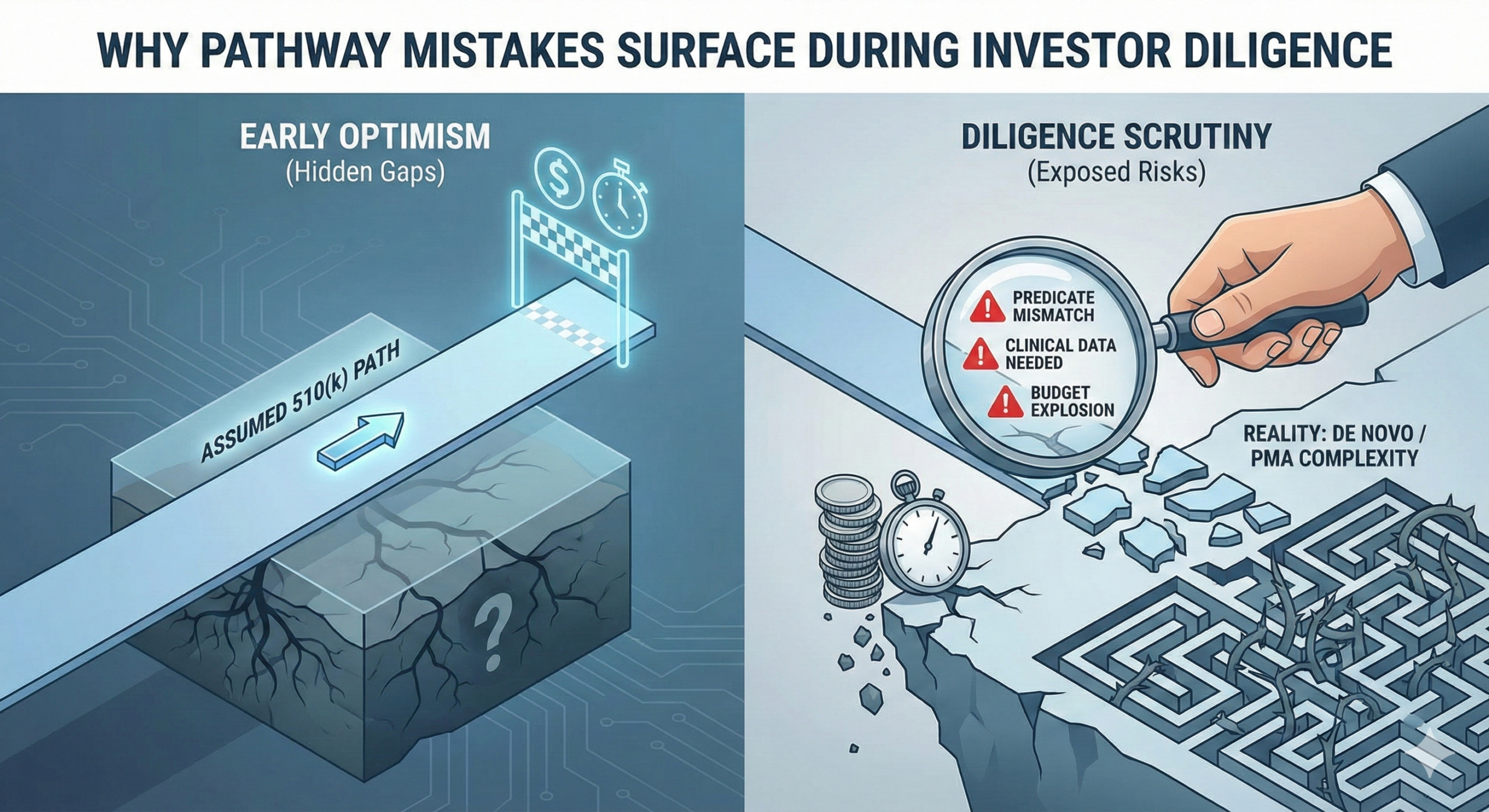
Short answer: incorrect FDA pathway assumptions don’t usually fail at the beginning. They fail when investors start asking hard questions.
Early on, optimism hides regulatory gaps. During investor diligence, those gaps get exposed.
That’s because regulatory pathway decisions—510(k), De Novo, or PMA—are not just technical. They define your timeline, capital needs, and exit strategy.
When the pathway is wrong, everything built on top of it starts to wobble.
Why Pathway Mistakes Don’t Show Up Immediately
In early development, teams focus on:
Prototyping
Early testing
Market positioning
Pitch decks
Regulatory details often feel like something to “finalize later.”
But the U.S. Food and Drug Administration doesn’t evaluate devices based on ambition. It evaluates them based on risk, intended use, and evidence.
If your regulatory pathway assumption is off—even slightly—it may not hurt you at the concept stage. It hurts when someone pressure-tests your logic.
That “someone” is usually an investor.
What Investors Ask During Regulatory Diligence
Experienced investors look for three things:
1. Is the Pathway Realistic?
They ask:
What is your device classification?
What predicate device are you using?
Why is 510(k) viable?
What happens if FDA disagrees?
If the answers are vague, overly optimistic, or defensive, confidence drops immediately.
2. Does the Evidence Plan Match the Pathway?
Investors check whether:
Bench testing aligns with risk level
Clinical studies are required (and budgeted)
Human factors and biocompatibility are addressed
Timelines reflect FDA review cycles
If you claim a moderate-risk pathway but your technology looks novel or higher risk, that disconnect becomes obvious.
3. Does the Budget Reflect Regulatory Reality?
Incorrect pathway assumptions distort:
Testing budgets
Clinical study plans
Submission timelines
Cash runway
A company planning for a 510(k) that actually requires De Novo or PMA can face:
12–36 months of additional development
Millions in unexpected costs
Emergency fundraising under pressure
Investors know this risk well.
Why Pathway Errors Always Surface in Diligence
Pathway mistakes rarely collapse programs on day one. They collapse credibility during diligence because:
Regulatory logic gets scrutinized
Assumptions are challenged
Risk is quantified
Timelines are stress-tested
When regulatory planning started late, answers feel uncertain. That uncertainty translates directly into valuation adjustments—or lost deals.
Regulatory risk is investor risk.
The Most Common Pathway Mistakes
Here are patterns investors recognize quickly:
Assuming a 510(k) exists without confirming predicate similarity
Ignoring technological differences that create new safety questions
Underestimating clinical evidence requirements
Expanding intended use beyond what the pathway supports
Treating De Novo as “just a longer 510(k)”
These are not minor errors. They reshape capital needs and exit timing.
Where Kandih Comes In
This is where Kandih Group helps teams align regulatory narrative with regulatory reality.
Kandih supports companies by:
Conducting structured pathway viability assessments
Analyzing intended use against FDA classification logic
Evaluating predicate strength and technological differences
Identifying risk escalators early
Building defensible regulatory timelines and cost models
Stress-testing pathway assumptions before investors do
Instead of reacting during diligence, teams enter diligence prepared.
Strong regulatory alignment signals:
Strategic maturity
Risk awareness
Capital discipline
That builds investor confidence.
Bottom Line
Pathway mistakes don’t fail early.
They fail when someone knowledgeable looks closely.
Investor diligence exposes regulatory optimism fast.
If your pathway is solid, diligence strengthens your story.
If it isn’t, it weakens it.
That’s why regulatory strategy should be aligned early—and tested before capital conversations begin.
References
FDA – Classify Your Medical Device
https://www.fda.gov/medical-devices/overview-device-regulation/classify-your-medical-device
FDA – Premarket Notification 510(k)
https://www.fda.gov/medical-devices/premarket-submissions/premarket-notification-510k
FDA – De Novo Classification Process
https://www.fda.gov/medical-devices/premarket-submissions/de-novo-classification-request
FDA – Premarket Approval (PMA)
https://www.fda.gov/medical-devices/premarket-submissions/premarket-approval-pma