Clinical Data as a Burn-Rate Event
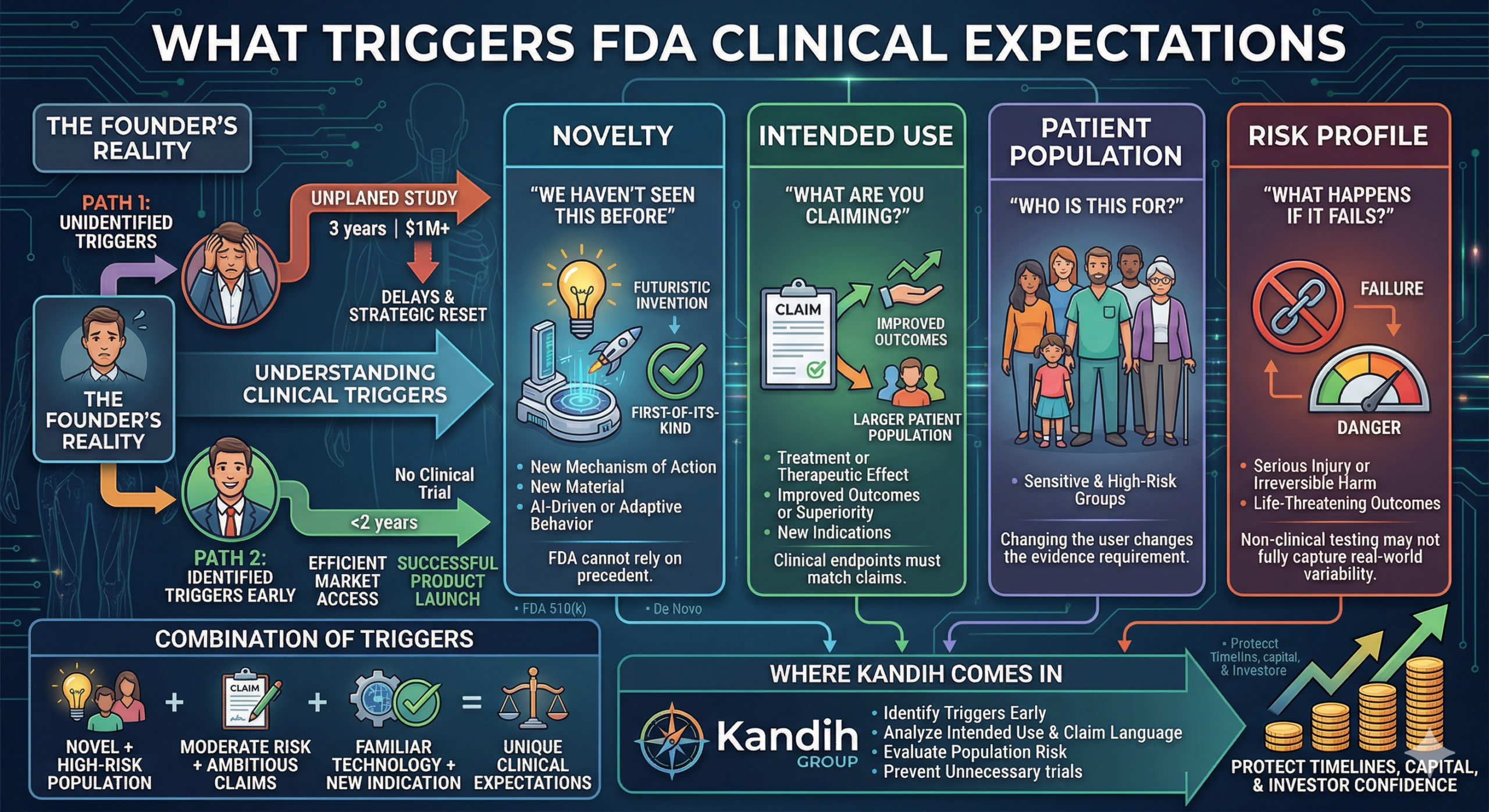
What Triggers FDA Clinical Expectations
March 25, 2026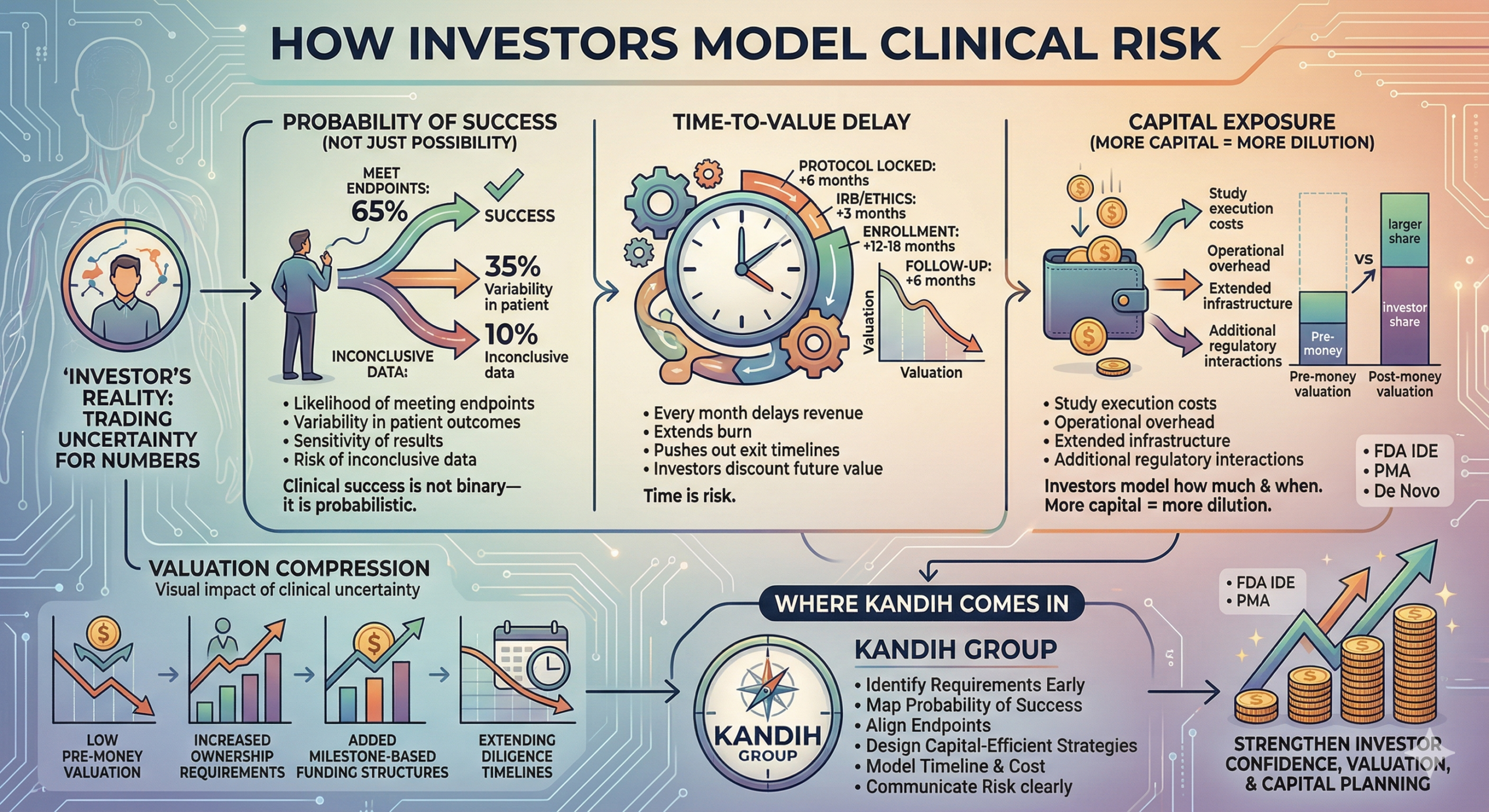
How Investors Model Clinical Risk
March 27, 2026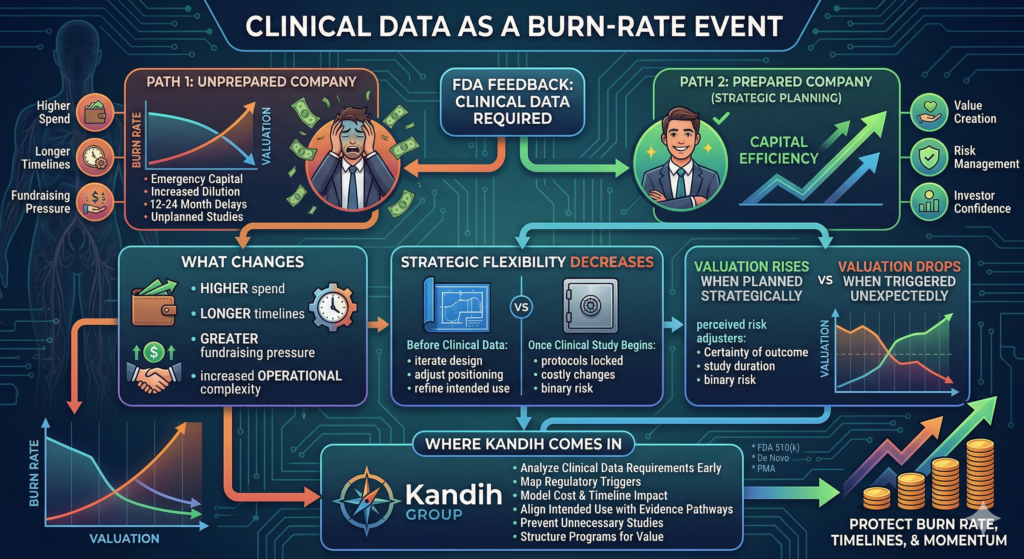
A founder once celebrated getting FDA feedback:
“Clinical data will be required.”
It sounded like progress.
Six months later, they were back in the market raising emergency capital.
Same device. Same team.
But now their burn rate had doubled—and their valuation had dropped.
Clinical data didn’t just change their regulatory plan.
It changed their company.
The Reality Most Teams Miss
Short answer: clinical studies are not just scientific milestones.
They are burn-rate events with direct impact on valuation.
When the U.S. Food and Drug Administration requires clinical data, it triggers a cascade:
Higher monthly spend
Longer timelines
Increased operational complexity
Greater fundraising pressure
Clinical strategy is financial strategy.
What Actually Changes When Clinical Data Is Required
1. Burn Rate Increases Immediately
Clinical studies introduce new cost layers:
Clinical site setup and monitoring
Investigator fees
Patient recruitment and retention
Data management and analysis
Regulatory and ethics oversight
Typical impact:
$1M–$5M+ per study
Burn rate increases by 2–3x
This is not incremental.
It is structural.
2. Timelines Extend—Even Before Results
Clinical studies require:
Protocol development
IRB/ethics approval
Site onboarding
Patient enrollment
Follow-up periods
Even efficient studies add:
12–24 months to development timelines
And delays are common.
Time is not neutral.
Time increases burn and reduces leverage.
3. Valuation Becomes Risk-Adjusted
Investors respond quickly to clinical requirements.
They ask:
How certain is the outcome?
How long will the study take?
What happens if endpoints are missed?
How much additional capital is needed?
The result:
Higher perceived risk
Lower valuation multiples
Increased dilution
Clinical studies introduce binary risk—they either validate the product or create new uncertainty.
4. Strategy Becomes Less Flexible
Before clinical data is required, companies can:
Iterate design quickly
Adjust positioning
Refine intended use
Once a clinical study begins:
Protocols are locked
Changes are costly
Strategic flexibility decreases
You are now committed to a path.
Why This Becomes a Problem
Many teams treat clinical trials as a regulatory checkbox.
They assume:
“We’ll run a study and move forward”
What they miss is:
Clinical studies reshape:
Capital planning
Timeline expectations
Investor dynamics
Exit strategy
This is where strong companies separate from reactive ones.
AEO: Common Questions About Clinical Studies and Cost
Why are clinical trials expensive for medical devices?
Because they require site management, patient enrollment, monitoring, and regulatory oversight.
Do clinical trials affect startup valuation?
Yes. They increase capital requirements and introduce outcome uncertainty, which impacts valuation.
Can companies avoid unnecessary clinical studies?
Yes, when non-clinical evidence is sufficient and properly aligned with FDA expectations.
The Strategic Question
The real question is not:
“Do we need a clinical trial?”
It is:
“When does a clinical trial create value—and when does it destroy efficiency?”
Because sometimes clinical data is necessary.
And sometimes it is avoidable.
Knowing the difference is everything.
Where Kandih Comes In
This is where Kandih Group helps founders treat clinical data as a strategic decision—not a default requirement.
Kandih supports teams by:
Identifying whether clinical data is truly required
Mapping regulatory triggers early
Designing evidence strategies that minimize unnecessary trials
Aligning intended use with achievable evidence pathways
Structuring clinical programs only when they add regulatory value
Modeling cost, timeline, and capital impact before decisions are made
Instead of reacting to FDA expectations, teams plan for them.
That protects:
Burn rate
Capital efficiency
Investor confidence
Development momentum
The Real Lesson
The founder at the beginning didn’t fail because they needed clinical data.
They struggled because they weren’t prepared for what clinical data would cost—in time, money, and control.
Bottom Line
Clinical studies are not just regulatory steps.
They are financial inflection points.
They increase:
Burn rate
Timeline
Risk exposure
When planned strategically, they create value.
When triggered unexpectedly, they create pressure.
Understanding that difference early turns clinical data from a liability into an advantage.
References
FDA – Premarket Approval (PMA)
https://www.fda.gov/medical-devices/premarket-submissions/premarket-approval-pma
FDA – De Novo Classification Process
https://www.fda.gov/medical-devices/premarket-submissions/de-novo-classification-request
FDA – Factors to Consider When Making Benefit-Risk Determinations
https://www.fda.gov/regulatory-information/search-fda-guidance-documents/factors-consider-when-making-benefit-risk-determinations-medical-device
FDA – Investigational Device Exemptions (IDE)
https://www.fda.gov/medical-devices/investigational-device-exemption-ide