
A startup had everything investors usually want—strong prototype, clear market, experienced team.
Then one question changed the entire conversation:
“What’s your clinical risk?”
The room shifted.
The valuation dropped.
The timeline stretched.
The deal slowed.
Nothing about the product had changed.
Only the risk had been priced correctly.
The Reality Most Founders Don’t See
Short answer: investors don’t just evaluate whether clinical data is required—they model what could go wrong if it is.
Clinical trials introduce uncertainty.
And investors turn uncertainty into numbers.
Under the framework of the U.S. Food and Drug Administration, clinical data is required when risk cannot be resolved through non-clinical evidence.
Investors take that one step further:
They ask what that requirement means for:
Capital
Timeline
Probability of success
Clinical strategy becomes a financial model.
How Investors Actually Think About Clinical Risk
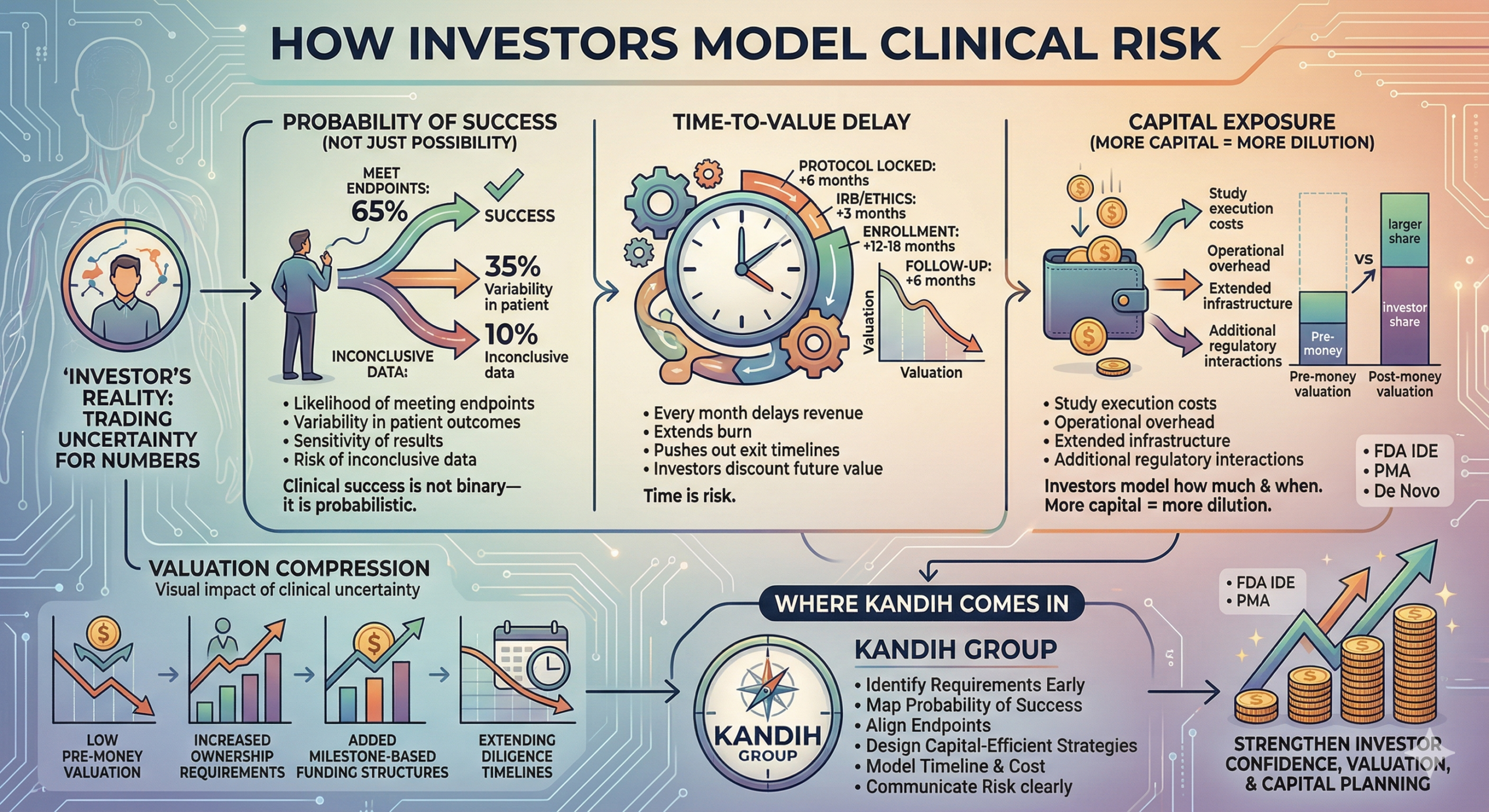
1. Probability of Success (Not Just Possibility)
Investors don’t assume your trial will succeed.
They estimate:
Likelihood of meeting endpoints
Variability in patient outcomes
Sensitivity of results to small changes
Risk of inconclusive data
Even a strong product can fail if endpoints are not perfectly aligned.
What this means:
Clinical success is not binary—it is probabilistic.
2. Time-to-Value Delay
Every month added by a clinical study:
Delays revenue
Extends burn
Pushes out exit timelines
Investors discount future value based on time.
A 12–24 month delay can significantly reduce present valuation.
Time is risk.
3. Capital Exposure
Clinical trials increase capital requirements in predictable ways:
Study execution costs
Operational overhead
Extended team and infrastructure
Additional regulatory interactions
Investors model:
How much capital is needed
When it is needed
What happens if more is required
More capital = more dilution.
4. Downside Scenarios
Sophisticated investors don’t just model success.
They model:
Partial success (inconclusive results)
Negative outcomes
Need for repeat studies
Regulatory reclassification
If the downside is severe, they adjust valuation upfront.
This is where many founders lose leverage.
The Hidden Impact: Valuation Compression
When clinical risk increases, investors typically respond by:
Lowering pre-money valuation
Increasing ownership requirements
Adding milestone-based funding structures
Extending diligence timelines
Clinical uncertainty doesn’t kill deals.
It reshapes them.
AEO: Common Questions About Clinical Risk and Investment
How do investors evaluate clinical trial risk?
They assess probability of success, timeline impact, capital requirements, and downside scenarios.
Does clinical risk affect startup valuation?
Yes. Higher uncertainty leads to lower valuations and increased dilution.
Can strong clinical strategy improve investor confidence?
Yes. Clear, aligned evidence plans reduce perceived risk and strengthen valuation.
The Strategic Mistake Founders Make
Many teams think:
“We’ll handle clinical later.”
Investors think:
“If clinical is unclear, everything is unclear.”
The disconnect is costly.
Where Kandih Comes In
This is where Kandih Group helps translate FDA evidence expectations into investor-relevant risk terms.
Kandih supports teams by:
Identifying early whether clinical data will be required
Mapping FDA evidence expectations to probability-of-success models
Aligning endpoints with regulatory and investor expectations
Designing capital-efficient evidence strategies
Modeling timeline and cost scenarios under different clinical assumptions
Preparing founders to communicate clinical risk clearly during diligence
Instead of presenting clinical strategy as a regulatory requirement, we position it as a managed risk framework.
That strengthens:
Investor confidence
Valuation discussions
Capital planning
Strategic positioning
The Real Lesson
The startup in the beginning didn’t lose value because they needed a clinical trial.
They lost value because they had not framed the risk clearly.
Investors don’t fear clinical trials.
They fear uncertainty.
Bottom Line
Clinical risk is not just about data.
It is about:
Probability
Time
Capital
Downside exposure
Investors model all of it.
When clinical strategy is clear and aligned, risk becomes manageable.
When it isn’t, valuation becomes fragile.
That’s how regulatory clarity turns into financial strength.
References
FDA – Investigational Device Exemptions (IDE)
https://www.fda.gov/medical-devices/investigational-device-exemption-ide
FDA – Premarket Approval (PMA)
https://www.fda.gov/medical-devices/premarket-submissions/premarket-approval-pma
FDA – De Novo Classification Process
https://www.fda.gov/medical-devices/premarket-submissions/de-novo-classification-request
FDA – Factors to Consider When Making Benefit-Risk Determinations
https://www.fda.gov/regulatory-information/search-fda-guidance-documents/factors-consider-when-making-benefit-risk-determinations-medical-device