
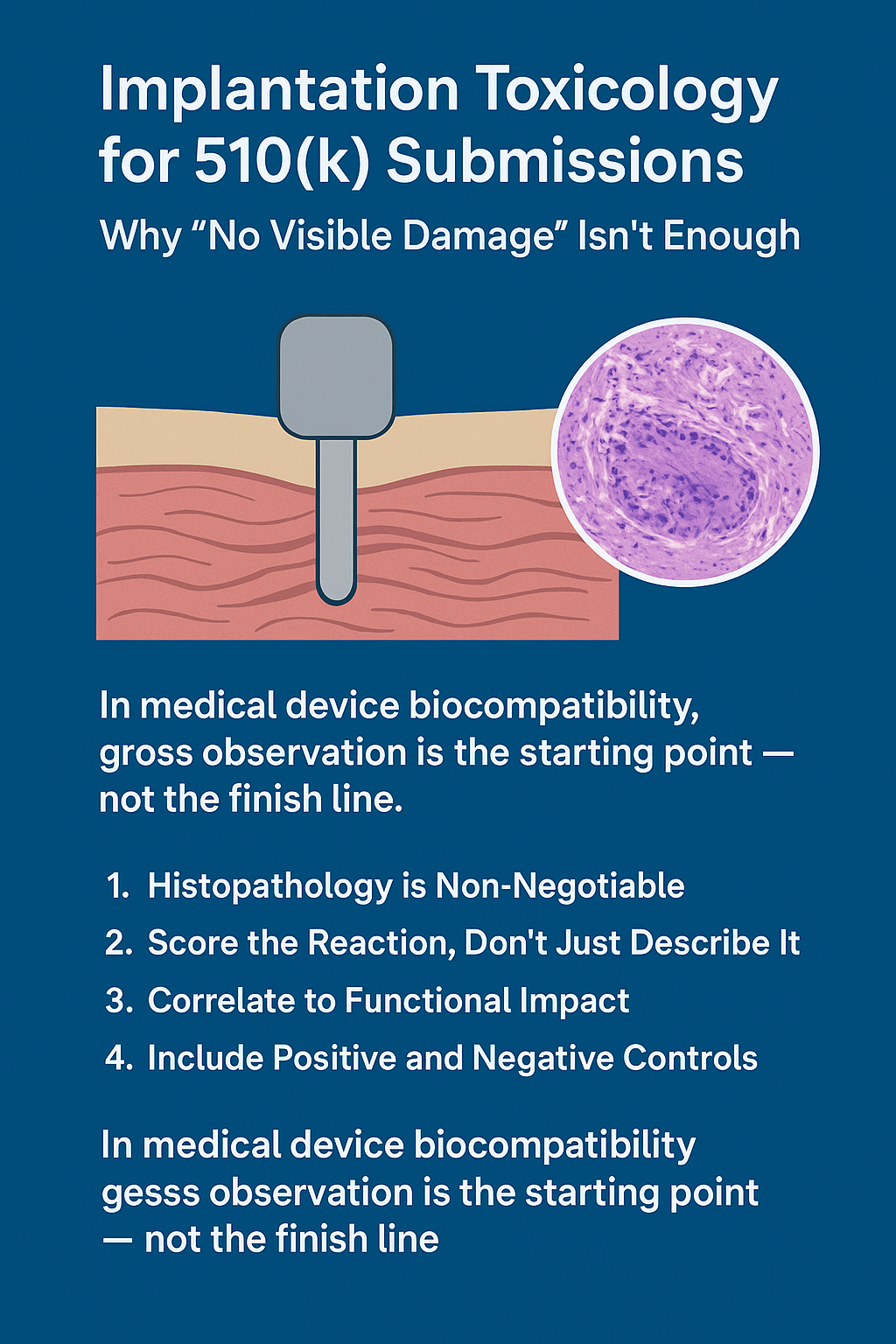
In medical device biocompatibility, gross observation is the starting point — not the finish line.
If your implantation study report for a 510(k) simply says “no visible tissue reaction”, you’re setting yourself up for FDA pushback.
Why? Because regulators know what seasoned toxicologists know: devices can cause microscopic and functional changes long before they cause visible tissue damage.
If you want your 510(k) to survive the first round of FDA review, your implantation study design must go beyond gross observation.
1️ Histopathology is Non-Negotiable
Don’t stop at “look-and-see.” Tissue around the implant must be processed, sectioned, stained, and examined under the microscope. This reveals:
- Inflammatory cell infiltration (acute or chronic)
- Fibrous capsule thickness
- Necrosis or calcification
These details tell the real safety story and often determine whether the device is deemed biocompatible.
2️ Score the Reaction, Don’t Just Describe It
Subjective descriptions (“minimal inflammation”) won’t cut it. Use ISO 10993-6 scoring systems for:
- Inflammation
- Fibrosis
- Neovascularization
- Foreign body reaction
A clear scoring system removes ambiguity and builds regulatory confidence.
3️ Correlate to Functional Impact
If the device’s function depends on tissue integration (e.g., orthopedic implants, vascular grafts), go beyond histology:
- Measure tensile strength of tissue-device attachment
- Assess patency in vascular models
- Test mechanical stability in load-bearing models
4️ Include Positive and Negative Controls
FDA reviewers want to see your study anchored in context.
- A negative control tells them what “normal” looks like in your model.
- A positive control demonstrates that your model can detect a harmful response if it’s there.
Without these, your “no reaction” finding is scientifically weaker.
Pro Tip for 510(k) Submitters
In your eSTAR biocompatibility section, don’t just attach the raw study report. Summarize:
- Study design and controls
- Key histopathology scores
- How these endpoints support substantial equivalence to the predicate device
This helps the FDA reviewer connect the dots without digging through 80+ pages of histology data.
Bottom line:
For implantation studies in a 510(k), “no gross tissue damage” is a minimum requirement, not the gold standard.
Microscopic, scored, and functional endpoints transform your study from “just enough” to “510(k)-ready.”
Need help designing an implantation study that passes FDA scrutiny the first time?
We help medical device developers build biocompatibility strategies that avoid costly delays. Let’s talk before your protocol is locked.
Call /email us:
240.565.8933
kandih.com